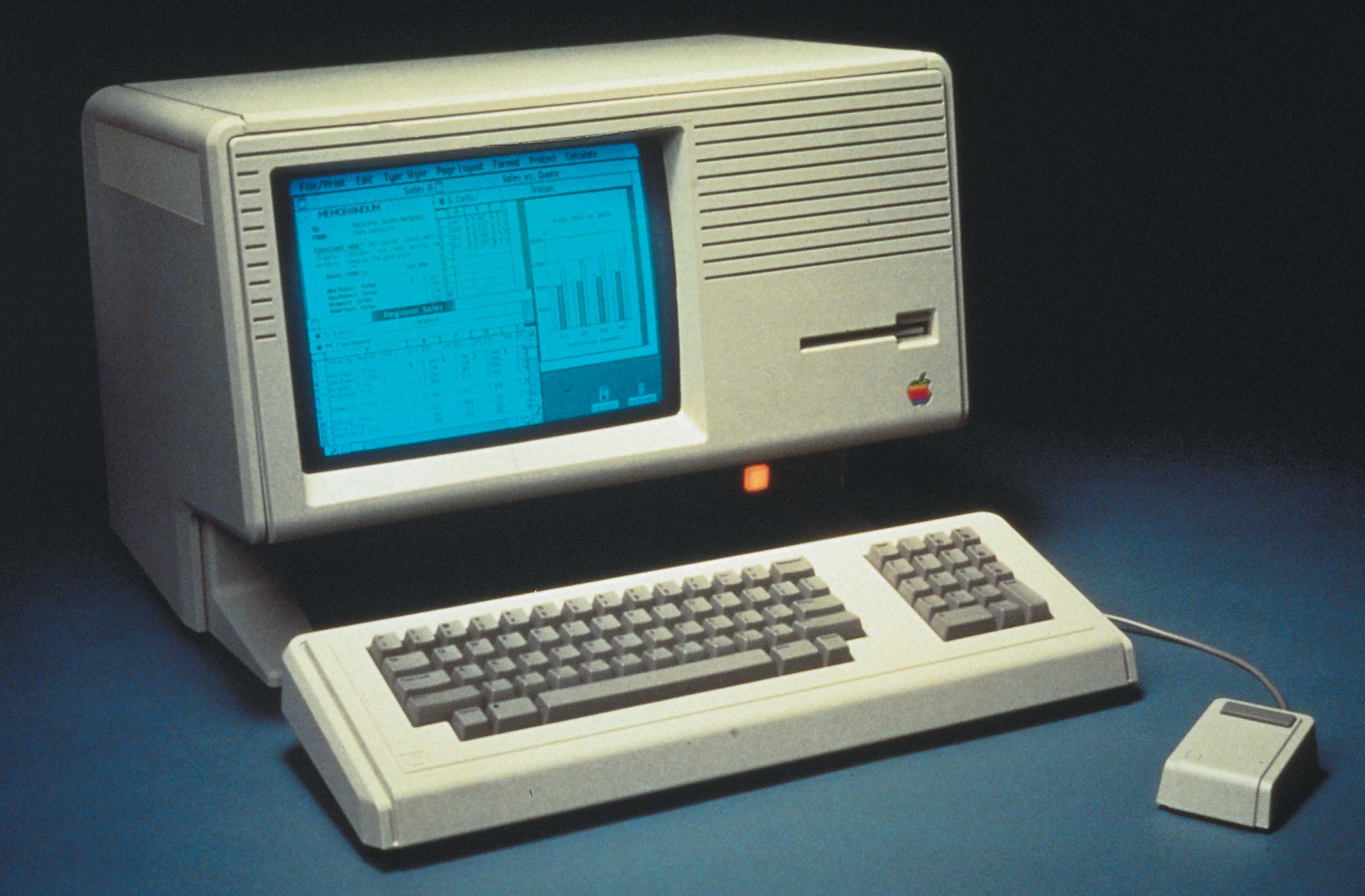
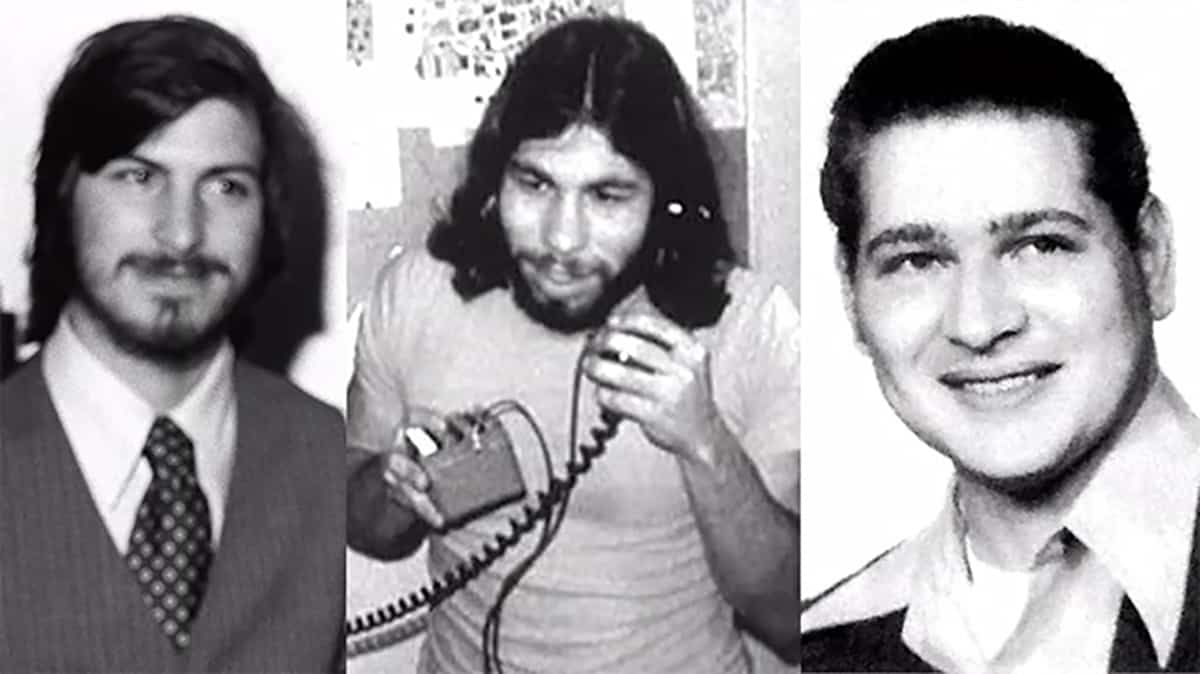
When you talk about the founders of Apple, you first think of Steve Jobs and Steve Wozniak. Jobs, the far-sighted business strategist – and „Woz“, the brilliant inventor. In fact, the Apple Computer Company was founded by three men: „Mr. Stephen G. Wozinak, Mr. Steven P. Jobs and Mr. Ronald G. Wayne“, as it is also stated in the company’s founding contract of April 1, 1976.
Three men founded Apple Computer on April 1st, 1976
Ron Wayne worked at Atari before founding Apple Computer, where he met Steve Jobs, who was involved in new game development. Through Jobs, Wayne became aware of Steve Wozniak, a brilliant hardware designer and engineer who had created the first usable personal computer that would go down in technological history as the Apple I.
But it soon became clear that the two Steves were pursuing very different goals: Steve Wozniak wanted to impress his pal’s guys at the Homebrew Computer Club with his brilliant development steps. Woz had no serious interest in making a big business out of it. Steve Jobs, on the other hand, quickly recognized the business potential. With a computer like Apple, I could break the dominance of the mainframes of companies like IBM and turn the personal computer into a mass product.
However, Jobs was not able to match his interests with Woz. Therefore he relied on Ron Wayne. So he and against this background offered him a minority share in the foundation of Apple Computer on April 1, 1976. Wayne had a 10 percent stake in the company, and Jobs and Wozniak each held 45 percent. Ron Wayne was to tip the scales when the two main players were at loggerheads with each other. „We both trusted him so much that he would resolve any conflicts we had,“ said Steve Jobs.
The first larger order came from the Byte Shop
r Wayne got cold feet: „I was practically the adult in the room. I was in my 40s, those kids were around 20. Then about a week and a half later, when I had time to think, I did what most people thought was absolutely crazy. I had my name taken off the contract.“
Wayne was particularly worried about the financial obligations associated with the first major contract for Apple computers. Jobs was in the process of signing supply contracts for the Apple I with first customers like „The Byte Shop“. He was getting the components for it on tick.
„I had very good reasons to remove my name from the contract,“ Wayne said in a 2016 TV interview looking back. „The main reason was that we had started a company. And if we failed, Jobs and Woz would not have had two nickels in their pockets. Who would be left to stick? Well, I had a house and a car, and a bank account, too. I was handy. So I was financially vulnerable. But I also wanted to be my own man. I also realized I was in the shadow of two grand. I was never gonna get my own project. I didn’t like the idea of spending the next 20 years behind piles of paper in an office. That was another reason to get out.“
Ron Wayne talks to Jules Pochy und Jérôme Schmidt (2016)
His co-founder Steve Wozniak could not understand this step. „I don’t know why Ron gave up. „He sold his shares and got out. He may have had good reasons. He got out and he was happy with it. He couldn’t see the big picture. But you couldn’t see the big picture at the time. There was only the Apple I.“
Wayne could
not count on Steve Jobs‘ understanding. Jobs described the process as follows:
„He decided that he really wanted a VCR or something. So he sold us back
10 percent for eight hundred dollars.“
But there
were also reservations in the opposite direction: „I didn’t know whether
jobs were the kind of personality I wanted to work for either,“ Wayne said
in the ARTE interview (2016). „He was just the way he was. He knew exactly
what he wanted to do. And it was better not to get in his way. You would end up
with a footprint on your forehead. Jobs had a very aggressive character. And if
you had to choose between Steve Jobs and an ice cube to warm them up, you’d
snuggle up to the ice cube. But it was the only way he could achieve what he
had achieved with Apple. Apple was Steve Jobs.“
So Wayne has no regrets about getting out of Apple so early: „Those kids were wild hotshots, like whether you have to hold a tiger by the tail. If I’d stayed with Apple, I’d have been caught in a hurry. I’d just be the richest man in the cemetery.“
One thing in life Wayne does regret, though. In the mid-nineties, he saw an ad in a magazine for a company that dealt with autographs and signatures. He remembered the old Apple contract that was lying around in a closet collecting dust. Finally, he sold the historical document for 500 dollars to the autograph dealer.
Years
later, Wayne then saw on television how his old contract came under the hammer
for almost 1.6 million dollars at the Sotheby’s auction house.
„I’m sorry for this incident. But what can I say? It’s the story of my life, right? A day late and a dollar short in my pocket.“
Ron Wayne has left his mark on Apple’s history even after he left as a shareholder. The first trace should be removed quickly because Steve Jobs did not like the first logo of the young company, which Wayne had designed. „In this logo, which they had me design, I captured Wozniak’s bizarreness. The logo with Newton in this Gothic frame with the ribbon and the inscription ‚Apple Computer Company‘ was of course a 19th-century design, not a 20th-century design. I knew that already.“
The second mark was deeper: Jobs asked Wayne if he could design a case for the Apple II. Although his design was never used. But Apple adopted the basic design principle.
Design for a housing for the Apple II by Ron Wayne.
To this day, Wayne is amused by the thought that he may have influenced all his later work. „A typical computer today consists of a tower and a circuit board mounted vertically. The keyboard and screen are separate. In my design for the Apple II, I had a horizontal design with a horizontally mounted board. The keyboard was integrated into the housing. The monitor stood on top, as one unit. They used this design for all future models, the Macintosh and Lisa, and so on. All were built this way. This form was unique among modern computers.“
Microsoft and Apple have been business partners and tough competitors for many years. Back in the seventies, Steve Jobs and Bill Gates worked close together. In 1997 the Windows-manufacturer helped Steve Jobs saving Apple.
In the early seventies there was no such thing as a personal computer. I took geniuses and visionary like Steve Wozniak and Bill Gates to invent this new industry. The early computer geeks were energized by the arrival of the January 1975 issue of Popular Mechanics, which had on its cover the first personal computer kit, the Altair. The Altair wasn’t a real computer —more a $495 pile of parts that had to be soldered to a board that would then do little—but for hobbyists and hackers it heralded the dawn of a new era. Bill Gates and Paul Allen read the magazine and started working on a version of BASIC, an easy-to-use programming language, for the Altair. It also caught the attention of Jobs and Wozniak.
Later Steve Jobs had to ask for the Microsoft BASIC because his friend Wozniak didn’t finish his own version of NASIC for the Apple II. “He was very childlike,“ said Jobs later to the author of hi biography, Walter Isaacson, abou „Woz“. „He did a great version of BASIC, but then never could buckle down and write the floating-point BASIC we needed, so we ended up later having to make a deal with Microsoft. He was just too unfocused.“
With the rise of the Apple II in the late seventies Microsoft became more and more successful – even before the IBM PC was invented. When Apple developed the Macintosh Bill Gates and his team were the most important software partner – despited the fact that Microsoft was also the driving force behind the IBM PC and the PC clones. And Steve Jobs even invited Bill Gates for the preview of the Mac: The high point of the October 1983 Apple sales conference in Hawaii was a skit based on a TV show called The Dating Game. Jobs played emcee, and his three contestants, whom he had convinced to fly to Hawaii, were Bill Gates and two other software executives, Mitch Kapor and Fred Gibbons. As the show’s jingly theme song played, the three took their stools.
Gates, looking like a high school sophomore, got wild applause from the 750 Apple salesmen when he said, “During 1984, Microsoft expects to get half of its revenues from software for the Macintosh.” Jobs, clean-shaven and bouncy, gave a toothy smile and asked if he thought that the Macintosh’s new operating system would become one of the industry’s new standards. Gates answered, “To create a new standard takes not just making something that’s a little bit different, it takes something that’s really new and captures people’s imagination. And the Macintosh, of all the machines I’ve ever seen, is the only one that meets that standard.”
Title of BusinessWeek (October 3rd, 1983)
But even as Gates was speaking, Microsoft was edging away from being primarily a collaborator with Apple to being more of a competitor. It would continue to make application software, like Microsoft Word, for Apple, but a rapidly increasing share of its revenue would come from the operating system it had written for the IBM personal computer. The year before, 279,000 Apple IIs were sold, compared to 240,000 IBM PCs and its clones. But the figures for 1983 were coming in starkly different: 420,000 Apple IIs versus 1.3 million IBMs and its clones. And both the Apple III and the Lisa were dead in the water.
Just when the Apple sales force was arriving in Hawaii, this shift was hammered home on the cover of Business Week. Its headline: “Personal Computers: And the Winner Is . . . IBM.” The story inside detailed the rise of the IBM PC. “The battle for market supremacy is already over,” the magazine declared. “In a stunning blitz, IBM has taken more than 26% of the market in two years, and is expected to account for half the world market by 1985. An additional 25% of the market will be turning out IBM-compatible machines. (Walter Isaacson, p. 159-160)
Apple boss John Sculley’s marketing strategy for the launch of the Macintosh was obvious. The former Pepsi manager, who had been brought to Apple by Steve Jobs, intended to arrange a duel between IBM and Apple, black vs. white, with Apple playing the role of the underdog. Sculley wrote in his book Odyssey:
So we needed a campaign that would focus on a two-horse race to leverage off of Apple’s underdog status. Dozens of other computer companies were coming out with products and I was afraid we were going to get lost in the crowd. If we could create a two-horse race between us and IBM, we might be able to convince people that there are really only two computer companies competing in the marketplace. In any large consumer industry, few people remember the third- or fourth-largest competitor.
In the fight against competitors such as Atari, Commodore, Sinclair and Amstrad, the Apple strategy paid off well. But Sculley, as well as Steve Jobs, had completely underestimated that Microsoft, being an ally from the outset, would, with the aid of Apple, develop into a dominant power of the PC industry and even dwarf IBM.
Bill Gates und Paul Allen (1981)
Bill Gates and Paul Allen had founded Microsoft as a small software company in Albuquerque (New Mexico) in 1975 and developed the programming language BASIC for the legendary computer MITS Altair in collaboration with other co-workers. Due to fortunate circumstances, Microsoft landed the order from IBM to deliver not only BASIC, but also the operating system for the first IBM PC in 1980. In the negotiation phase, the then leading operating system manufacturer Digital Research (CP/M) did not want to engage in page-filling adhesion contracts from IBM – and thus lost this gigantic deal.
Though Microsoft did not have any operating system at that time, this did not prevent Bill Gates and his companion Steve Ballmer from playing for high stakes while facing IBM. From their neighboring software shack Seattle Computers (in the mean time, Microsoft had moved to the northwest of the USA) they bought all rights for QDOS (Quick and Dirty Operating System) for no less than 50,000 dollars in July 1981 and renamed it as MS-DOS. Gates had been clever enough at that time not to have all rights to the system negotiated away by the IBM crew and was therefore able to win clone companies such as Compaq as customers later.
When Microsoft provided their BASIC for the Apple II, Steve Jobs and Bill Gates constantly ran into each other at that time. “Even before we finished our work on the IBM PC, Steve Jobs came and talked about what he wanted to do, what he thought he could do, sort of a Lisa but cheaper. We said boy, we’d love to help out”, Gates remembers. “The Lisa had all its own applications, but of course they required a lot of memory, ah, and we thought we could do better, and so Steve signed a deal with us to actually provide bundled applications for the first Mac, and so we were big believers in the Mac and what Steve was doing there.”
Apple urgently needed software for the Mac, as there did not yet exist any program for the new system except for their in-house products MacWrite and MacPaint. Gates promised to have the programs Chart and File written for the Mac in addition to the spreadsheet program Excel. Steve Jobs appreciated the risk Microsoft took, but was not content with the first results though. “Most people don’t remember, but until the Mac, Microsoft was not in the applications business… it was dominated by Lotus. And Microsoft took a big gamble to write for the Mac.”
Apple still could have coped well with having given Microsoft’s new application business a leg up. However, Bill Gates had tasted blood in the Macintosh project. Jeff Raikes, who was responsible for the Office business at Microsoft until early 2008, reviews: “And so we got started in early 1982 on our Macintosh software effort and I think at that point in time, you know, it really clicked with Bill that, you know, graphic user interface was going to be the way, the way of the future. But while Bill was having his own GUI revelation, Jobs believed that Apple’s true enemy was IBM.”
Quote of the movie: „Pirates of Silicon Valley“ – Microsoft steals from Apple
In June of 1985, Bill Gates sent a remarkable memo to both the then-CEO of Apple, John Sculley, and then-head of Macintosh development, Jean Louis Gassée, and urged them to spread their wings by licensing their hardware and operating system to other companies.
Apple must make Macintosh a standard. But no personal computer company, not even IBM, can create a standard without independent support. Even though Apple realized this, they have not been able to gain the independent support required to be perceived as a standard.
Apple ignored his advice.
Five months after he sent the memo, Windows 1.0 was released. Microsoft’s decision to do exactly as Gates had recommended to Apple resulted in market domination. Had Apple taken Gates‘ advice, things could have been so very different.
Apple co-founder Steve Wozniak has since said:
„The computer was never the problem. The company’s strategy was. Apple saw itself as a hardware company; in order to protect our hardware profits, we didn’t license our operating system. We had the most beautiful operating system, but to get it you had to buy our hardware at twice the price. That was a mistake. What we should have done was calculate an appropriate price to license the operating system. We were also naive to think that the best technology would prevail. It often doesn’t.“
Windows 1.01 was based on DOS and was incredibly slow, but it reminded one of the Macintosh GUI in some features. In order to prevent Apple from taking legal action, Gates put the screws on Apple boss Sculley. His message was: As soon as Apple sends out the lawyers, Microsoft will immediately stop the development of Word and Excel for the Mac. Since Apple was depending on the Microsoft applications, Sculley licensed some of the Mac technologies to Microsoft.
As Microsoft went public with the next large version leap of Windows 2.03 at the beginning of 1988, Sculley tried to pull the ripcord and sued Microsoft and Hewlett-Packard for copyright infringement on March 17, 1988. John Sculley had been in a difficult situation, particularly as he had engaged in vague formulations in the contract with Microsoft in 1985, which gave great leeway to Gates and his lot. Moreover, he knew that his chances to win an action against Microsoft had been, purely from a legal viewpoint, not particularly good: “The look and feel, which is how it looks, the experience of using it, was not patentable, but it was copyrightable, but there was no precedent law. This was going to be a precedent setting case.”
Parody of an advertising spot for Windows featuring Steve BallmerBill Gates recalls also reluctant this time.: „But it was a period of five years where, Microsoft er, our whole strategy would have been ruined because Windows was very important to us. (…) We assumed that the lawyers, the judges would all come to the right conclusion which eventually they did.“ Sculley: „And Apple lost. But in that period of about six years that this case was going on it may have lulled us into a bit of complacency thinking that we were going to be insulated, you know, from the Windows attack.“
The introduction of Windows 3.1 in 1992 brought Microsoft the breakthrough in the “GUI war”. The system lacked the elegance and usability of the Macintosh system 7.0, but Windows appeared good enough to most PC users. With the help of Windows 95, which had been introduced with gigantic effort on August 24, 1995, Microsoft caught up closer to the Mac and in some aspects even appeared more progressive than the Mac OS, which had become dated in the meantime.
Steve Jobs, who, as the head of NeXT, had observed the advance of Windows from a distance, did not have any kind words for Bill Gates at the launch of Windows 95:
The only problem with Microsoft is they just have no taste, they have absolutely no taste, and what that means is – I don’t mean that in a small way, I mean that in a big way. In the sense that they don’t think of original ideas and they don’t bring much culture into their product, and you say why is that important – well you know proportionally spaced fonts come from type setting and beautiful books, that’s where one gets the idea – if it weren’t for the Mac, they would never have that in their products and so I guess I am saddened, not by Microsoft’s success – I have no problem with their success, they’ve earned their success for the most part. I have a problem with the fact that they just make really third rate products.
It is claimed that Jobs has apologized to Bill Gates for this remark later.
Steve Jobs about Microsoft (1995)
The relationship between Apple and Microsoft – and thus also the relationship between Steve Jobs and Bill Gates – did not get back to normal before the summer of 1997, when Steve Jobs had returned to Apple and engaged in the support of Microsoft in order to make the troubled company profitable again.
Bill Gates on the video screen at the MacWorld Expo 1997 in Boston
Many faithful Apple fans still remember with horror the moment when Steve Jobs announced the former archrival very pragmatically as the knight in shining armor at the MacWorld Expo 1997 in Boston with Bill Gates appearing on an oversized video screen just like “Big Brother.” Introducing Gates, Jobs said: ““We have to let go of the notion that in order to for Apple to win, Microsoft has to lose. Relationships that are destructive don’t help anybody. The era of setting this up as a competition between Apple and Microsoft is over.”
Microsoft invested 150 million dollars in 150,000 Apple stocks and, according to certain rumors, paid further 100 million dollars for copyright infringement during the past few years. At the same time, Gates obliged himself to continue the development of the Internet Explorer and Microsoft Office for the Mac for the following five years. Gates drew hisses from the audience of Apple faithful. The crowd also groaned when Steve Jobs said Apple would make Microsoft’s Internet Explorer the default browser for viewing the World Wide Web on Macintosh computers. That development was a blow to Netscape Communications Corp., which made a more popular competing browser and lost later on in the famous „browser war“ against Microsoft.
In October 2015 Steve Ballmer appeared on Bloomberg TV where the former executive briefly touched on Microsoft’s monumental 1997 investment in Apple.
At the time, Microsoft’s deal with Apple not only helped rescue the company from the brink of bankruptcy, it gave Apple a much-needed lifeline, affording the company room and time to innovate. And as we all know, the deal ultimately helped set Apple up for the most astounding tech resurgence in history.
https://www.facebook.com/watch/?v=970956106278806
In 2010 – after a stunnishing comeback – Apple Inc. overtook Microsoft Corp. to become the most valuable technology company on optimism it can keep adding customers for its iPhone, Macintosh computer and iPad. On May 26th by 4 p.m. New York time in Nasdaq Stock Market trading, Apple’s market value was at $222.1 billion, higher than Microsoft’s $219.2 billion. That made Apple the most valuable technology firm in the world.
In an interviews with Kara Swisher and Walt Mossberg from the Wall Street Journal Apple CEO Steve Jobs downplayed the significance of Apple’s passing Microsoft in market value. „For those of us who have been in the industry a long time, it’s surreal,“ Jobs said. „But it doesn’t matter very much, it’s not what’s important.
„It’s not why any of our customers buy our products. So I think it’s good for us to keep that in mind.“
„They just don’t get it.“ That’s how Steve Jobs described his digital rivals Microsoft and Google in an interview with his biographer Walter Isaacson.
For his biography, „Steve Jobs,“ Isaacson conducted more than 40 taped interviews with the Apple co-founder and CEO – all of them done while Apple was on its ascent with one great product after another, but Jobs was on his decline, ill with a form of pancreatic cancer that would end his life at age 56.
Update:
JOBS AND GATES TOGETHER The boy wonders of computing, now thirtysomething, argue over where innovation comes from and where PCs will go.
By Steven P. Jobs, William H. Gates III, Brenton R. Schlender
August 26, 1991
(FORTUNE Magazine) – The two college dropouts most responsible for unleashing the PC revolution rarely see each other anymore, though they say that they’re still friends. At FORTUNE’s invitation, Bill Gates and Steve Jobs met for a Sunday evening in late July to discuss the prospects for the tumultuous industry they shaped. Gates, 35, left Harvard in 1975 to co-found Microsoft. His big break came in 1980, when IBM asked him to provide the operating system — the program that manages a computer’s inner workings — for its now famous PC.
Jobs, 36, who left Reed College to sojourn in India, is best known for co-founding Apple Computer. He led the development of the Macintosh, a computer much easier to use than IBM’s somewhat nerdy PC. Gates has imitated many features of the Mac’s software with a popular PC program called Windows.
Since the mid-1980s the men have taken dramatically different paths. Gates, who owns more than $4 billion of Microsoft stock, remains a workaholic bachelor and an omnivorous reader — he has read several biographies of Napoleon. He has built Microsoft into the world’s largest and most profitable PC software company. It hasn’t all been rosy. Microsoft’s relationship with IBM soured this year, mainly because the two couldn’t agree on an operating- system strategy for future PCs. And the Federal Trade Commission recently began investigating Microsoft’s practices.
Jobs has been less visible but just as busy. In 1985 he started Next, aiming to build the personal computer of the 1990s. Next’s first machine appeared two years ago. Its basic software, NextStep, makes the machine unusually easy to customize; IBM was so impressed it licensed NextStep for its own computers. Despite the dazzling technology, the going has been slow at Next. For one thing, IBM never put NextStep on the market. But lately business has picked up — 10,000 systems rolled out of Next’s automated plant during the second quarter. Jobs has other reasons to smile. He and wife Laurene, who married earlier this year, are expecting their first child in September.
FORTUNE associate editor Brenton R. Schlender put the questions at the meeting. Beneath the conviviality, Jobs and Gates each had a business objective. Jobs lobbied for Gates to develop software for the Next computer. And Gates, whose company is being sued by Apple for allegedly pirating Macintosh software features, was hoping to learn more about the product’s origin.
Schlender: What did you think when the PC appeared ten years ago?
Jobs: When IBM entered the market, we did not take it seriously enough. It was a pretty heady time at Apple. We were shipping tens of thousands of machines a month — more computers than IBM was total. Even so, a lot of people think IBM invented the personal computer, which of course isn’t true.
Gates: A lot of people think Apple did, and that isn’t true either. Our first program was for the Altair ((a mail-order kit sold in 1975)).
Schlender: Does Microsoft’s control of PC operating systems stifle competition in the industry?
Gates: There’s not one element of the industry that’s not competitive. There are people who are cloning Intel’s chips; there are people who are cloning my operating system; there are many, many people who make PCs; and for every software application there are lots of people competing. There is no competitive imperfection.
Jobs: How come nobody has successfully competed with you? I’m not accusing you or Microsoft of anything. I’m not even saying it’s necessarily bad. I’m just saying it’s an interesting contrast. When I zoom back and look at this, there are hundreds of people making PCs, and hundreds of people writing applications programs for them.
Gates: Right.
Jobs: But they all have to travel through this very small orifice called Microsoft to get to one another.
Gates: It’s a very large orifice! ((Laughs.))
Jobs: But it’s only one company.
Gates: Are you saying there’s something wrong with our popularity? My approach to the PC market has been the same from the very beginning. The goal of Microsoft is to create the standard for the industry. Nothing has changed.
Schlender: What does the future hold for IBM and Apple? What do you think of their decision to collaborate on PC software?
Gates: It’s surprising to me.
Jobs: Yes, we are confused about that.
Gates: ((Apple President)) Mike Spindler has said they want to turn Apple into more of a software company. If that’s your goal, you don’t go and give the half of the company that is the future of Apple software to a joint venture. What is Apple getting in return? Here’s the part I don’t understand: What is the contribution from IBM? The IBM name? Did Apple feel so bad about their own work that they had to have that?
Jobs: I truly believe the challenge for IBM is that they can’t survive by selling the same thing you can buy from somebody else for 30% less money. Their cost structure doesn’t allow them to compete with companies that don’t do massive amounts of R&D, that don’t have twice as many employees as they need, et cetera, et cetera. So IBM has to do one of two things: One, suffer continuous erosion of its market share until eventually it goes out of business, which I hope doesn’t happen. Or two, come up with some way to add value. In my opinion the way to make your machines unique is with unique software.
Gates: I said that back in the Seventies! ((Laughs.)) There’s something else I don’t understand. If IBM already held a license to your NextStep software, why did they get all this going with Apple rather than just come to you and expand their license?
Jobs: I really want to answer this question, but I’ve got to be careful what I say. It’s not my purpose to alienate anyone at IBM.
Gates: We share this interest. ((Both laugh.))
Jobs: Somebody at IBM a few years ago saw our NextStep operating system as a potential diamond to solve their biggest and most profound problem, that of adding value to their computers with unique software. Unfortunately, as I learned, IBM is not a monolith. It is a very large place with lots of faces, and they all play musical chairs. Somewhere along the line this diamond got dropped in the mud, and now it’s sitting on somebody’s desk who thinks it’s a dirt clod. Inside that dirt clod is still a diamond, but they don’t see it.
Schlender: Is the PC industry, which until now has been dominated by American companies, liable to get overrun by the Japanese?
Jobs: Computer companies fall on a spectrum of enthusiasm for manufacturing. On the left end are companies that look at manufacturing as a necessary evil, who wish they didn’t have to do it. And at the far right you have people who look at manufacturing as a competitive advantage. Clearly a lot of the Japanese companies look at themselves that way. Unfortunately a lot of American companies look at manufacturing as a necessary evil. You can say the same thing about the way they see software. My opinion is that the only two computer companies that are software-driven are Apple and Next, and I wonder about Apple. Most computer companies would rather that software didn’t even exist.
Gates: Good!
Jobs: It’s good for Microsoft today. But unfortunately all those companies could give way to Japanese companies a few years down the road.
Gates: I think you give up too easily on Americans. You pick one dimension . . .
Jobs: I focus on manufacturing because I care about it. I’ve seen IBM’s. I built Apple’s and Next’s, and I know what Sun does. Ultimately, I believe that most of the PCs will come from offshore. We’re just not good enough at manufacturing.Where will the key innovations come from? Established giants like Microsoft or upstarts like Next?
Gates: I contend technology breakthroughs can happen by extending what we already have. Let’s take handwriting computers. The hardware is coming from PC-compatible makers like Dell Computer ((of Austin, Texas)) and NCR and some Japanese companies. The software will come either from Microsoft or from a U.S. competitor named Go Corp. ((of Foster City, California)). That’s going to be a major breakthrough, and who do you give credit to?
Jobs: I think everybody gives credit to Go, but Go will be crushed.
Gates: That’s one of the nastiest comments I’ve ever heard. I’ve been working on handwriting since long before there ever was a Go Corp.
Jobs: Really? I didn’t know that. Most people would say that Go is the company that first tried to commercialize that technology.,
Gates: Well, Go hasn’t shipped anything yet, and I’ll ship my stuff before they ship theirs.
Jobs: My experience has been that creating a compelling new technology is so much harder than you think it will be that you’re almost dead when you get to the other shore. That’s why, when you take big leaps, like the Mac, or object- oriented programming, or handwriting recognition, you have to leave old technology behind. When Lindbergh was going to fly from New York to Paris, he had to decide what to take with him. There were a lot of demands. They fell into two categories — things that would make his journey safer or more comfortable, and things that would increase his chances of making it to Paris. Weight was a real problem. He could take more gas, which would increase his safety, or he could take a compass, which would increase his chances of getting to Paris. Every time he came down on the side of increasing his chances of getting to Paris at the sacrifice of safety or comfort. That’s why he made it.
Gates: Smart people like Steve ought to try to build things from scratch. That’s a worthy thing. But every time it should be a test. Right now there’s a test in handwriting PCs, in object-oriented operating systems, in multimedia computers. Those are the big questions for personal computing in the 1990s, and I’m the one who has to prove the validity of the evolutionary approach.
Jobs: It’s true, your evolutionary approach with Windows is bringing to PCs great new technologies that Apple and others pioneered. But in the meantime — and it’s been seven years since the Macintosh was introduced — I still think that tens of millions of PC owners needlessly use a computer that is far less good than it should be.
Larry Tesler talks about Steve Jobs‘ trips to Xerox’s Palo Alto Research Center, including the one where Jobs eyed the company’s graphical user interface prototype — which ended up on Mac OS.
Introducer: Larry Tesler, I believe you took Steve on a tour of Xerox PARC and showed him some technology that became important. I wonder if you could tell us about that that tour?
Larry Tesler: Well it wasn’t the physical facility. It was a tour of the software it was part of that demonstration . Xerox was facing a lot of competition from Asian companies in copiers when their patents expired and one thing they found was that they had a very high manufacturing cost and they were really having trouble competing with these new forces in the market. At the same time they had Xerox PARC, developing very exciting technologies including the Ethernet, GUIs with windows and improved mice from what existed before.
They started worrying that they would not be able to manufacture those cheaply enough when they moved into that market. So they looked around and saw that Apple was cranking out Apple ][s for really cheap and selling lots of them and they thought, “Well, we should partner with a company like Apple and they’ll make our machines for us”. Or something like that. Xerox had some kind of idea of [that] type, so some business development peope came from the East Coast to PARC and when they got to Apple they made a deal where in exchange for various business arrangements, distribution and future discussion of manufacture and so on, Apple would sell them stock. This was a very appealing thing because it was very clear Apple was going to have a very successful IPO, […] and in exchange though, Steve Jobs required information… disclosure, everything cool going on at Xerox PARC [laughter] [voice commenting “Good bargain!”]. Nobody checked with the PARC people first but the business development people signed the deal.
So there was a number of visits [by Apple to PARC]. I was involved in a couple of them. One was [Apple] executives visiting and meeting with some of us [PARC researchers] trying to just get information out of us or an agenda for how to get the information out of us.
That was a little bit of a tense meeting but I remember at one point Steve was pacing the room trying not to be in charge of the meeting because he was not the CEO of the company – Mike Scott was – and at one point he just said “Stop! Stop! Stop! Stop! Stop this discussion! We need to tell them about the Lisa!” and all the Apple people kind of froze… “Come on! Come on, we need to tell them about the Lisa! This conversation is gonna go nowhere!”. So we got perked up, because it was us disclosing to them, not them disclosing to us, but finally they threw up their hands “OK, tell ’em about the Lisa!” so somebody told us a little about the Lisa, which at that time did not have a GUI but it was powerful enough to do the kinds of thing that they thought we were doing.
The next thing I remember was another meeting where apparently Apple people had been demoed in-between but they weren’t satisfied with the demo. They knew there was lot more than [what] we were showing them. There were a lot of people at PARC that didn’t want to show Apple everything. And in fact we all felt like we didn’t want to show them everything, but I was one of those who felt we should show them more. There were people who wanted to hold back everything we could. So they arranged a new set of demos, where more people came, Bill [Atkinson] was there, John Couch, Mike Scott, obviously Steve, Jef Raskin, [and] a couple of other people.
The room as pretty full and there were two or three of us from PARC at a time, one person sitting at the computer, getting the demonstration and the other people waiting their turn or observing. So, during that demo, Steve again got very excited. He was pacing around the room and occasionally looking at the screen. he was mostly just looking and reacting and taking it all in, trying to process it and at one point he said “You’re still not showing us everything!” And the meeting paused, there were some phone calls [made], and [then] “OK, we’re going to show you more.” [laughter]
So I gave my demo, then Dan Ingalls gave a demo for Smalltalk and they started asking us lot of questions. Bill and, Bruce Daniels was there too, he had joined Apple from MIT… those technical people just asking us questions and we were answering the questions and frankly I was amazed.
I had looked into Apple earlier, a couple of years before, because someone tried to get me to work there, and I found these people who were Homebrew Computer Club kinda hackers. Suddenly there were all these computer scientists in the room and they were asking really good questions! So I got a completely different view about what Apple was like from that meeting. But Jobs was saying “What is going on here? You’re sitting on a gold mine! Why aren’t you doing something with this technology? You could change the world!” And his buddies, who were trying to arrange the negotiation of some kind, were trying to quite him down [laughter] “Don’t be so excited!” But it was really clear to him that we [at Xerox] were never really gonna do anything with this, and by that I mean the kinds of revolutionary things that he was envisioning.
The irony was that when they left we still had shown the like only 1% of what PARC was doing but it was enough that they got really excited and decided they were going to retarget the Lisa to be something like what they had seen, in terms of GUI. They fell in love with the mouse and that changed everything. And seven months after I was working at Apple.”
Apple Lisa team: Paul Baker, Bruce Daniels, Chris Franklin, Rich Page, John Couch, and Larry Tesler.
John Carmack was the lead programmer of the id video games Commander Keen, Wolfenstein 3D, Doom, Quake, Rage and their sequels. Carmack is best known for his innovations in 3D graphics, such as his Carmack’s Reverse algorithm for shadow volumes. In August 2013, Carmack took the position of CTO at Oculus VR. His first meeting with Steve Jobs was quite interesting.
Apple is now (2017) the most valuable company in the world. But 20 years ago it looked like the company was about to completely implode. Nevertheless Apple was celebrating it’s anniversary. It had been twenty years since Apple had officially incorporated, and it marked the occasion with the Twentieth Anniversary Macintosh, or TAM. The machine was a technological showcase of the day, boasting a number of features beyond simple computing, and with a price tag aimed at the „executive“ market.
Released on March 20, 1997, the TAM was essentially the computing version of a concept car, an innovation showcase. It compared to a car in another way: it was expensive, costing $7,499 upon its release. After its launch event, The New York Timescalled the ambitious effort a „Ferrari-on-a-desktop.“
The TAM was an all-in-one PC, kind of a spiritual ancestor of the iMac, back when the whole idea of a monitor that contains the computer was totally crazy. It was designed by a young Jony Ive, who would go on to become Apple’s resident creative genius.
April 1, 1996 marked 20 years since the day that Steve Jobs, Steve Wozniak, and Ronald Wayne came together to form Apple Computer. As this milestone arrived and came to the attention of Apple’s then current executives, the decision was made to release a limited edition Macintosh computer to celebrate – and so the „Spartacus“ (or „Pomona“, or „Smoke & Mirrors“) project was born.
The normal time-span to develop a new Macintosh computer was 18+ months, however they were already late to the party. Luckily the design team had already been working on several „dream“ concepts, and soon settled on the most feasible of those – the (almost) „All-in-One“ LCD-based design. To cut down on development time, many off-the-shelf components were used on the new computer’s internals.
The TAM was announced almost 20 years to the day after Jobs and Wozniak incorporated the company, in January 1997 at MacWorld Expo, San Francisco. It was given a release date of March 20, 1997, with a retail price of US$7,499. Originally intended as a mainstream product, the marketing group turned it into a pricey special edition.
Specifications and design
The TAM was to break the established form factor of the personal computer. One of the first projects of Jonathan „Jony“ Ive, the design of the TAM was both a state-of-the-art futuristic vision of where computing could go whilst redeveloping Apple’s original objective to create a device that would integrate into people’s lives.
The TAM featured a 250 MHz PowerPC 603e processor and 12.1″ active matrix LCD powered by an ATI 3D Rage II video chipset with 2MB of VRAM capable of displaying up to 16bit color at either 800×600 or 640×480 pixels. It had a vertically mounted 4x SCSI CD-ROM and an Apple floppy Superdrive, a 2GB ATA hard drive, a TV/FM tuner, an S-Video input card, and a custom-made Bose sound system including two „Jewel“ speakers and a subwoofer built into the externally located power supply „base unit“.
A thick „umbilical“ cable connects the base unit to the head unit, supplying both power, and communications for the subwoofer. The umbilical connects via a multi-pin connector, which is a possible cause of the TAM’s one major fault – the „speaker buzz“. Inspections of units that received a repair by Apple due to the speaker buzz found an extra resistor/s had been installed in the umbilical. Ensuring the connectors are free of dust/dirt has also been known to resolve the „buzz“, though the buzz ultimately only affected a small percentage of machines. An Apple Engineer noted[5] that the thick umbilical was intended to power a higher end CPU, however that option was ultimately curtailed, though the diameter of the umbilical remained.
The TAM came with a unique 75 key ADB keyboard which featured leather palm-rests and a trackpad instead of a mouse. The trackpad could be detached from the keyboard if desired, with a small leather insert found underneath the keyboard ready to fill the gap. When not required, the keyboard could slide under the TAM’s head unit, leaving the trackpad exposed for continued access. The TAM also came with a remote control (standard with the Apple TV/FM Tuner card), but also featured buttons on the front panel that could control sound levels, CD playback, brightness, contrast, and TV mode. The pre-installed operating system was a specialized version of Mac OS 7.6.1, which allowed control over those features.
Expandability was offered via a 7 inch PCI slot and Apple Communication slot II for the addition of Ethernet. Later G3 upgrade options offered by Sonnet and NewerTechnologies made use of the TAM’s Level II Cache slot, which allow the computer to reach speeds of up to 500 MHz. All of these options come at the price of the TAM’s slim profile. The back panel must be removed, and replaced with an (included) „hunchback“ cover that adds several inches to the depth of the machine.
One last unique feature of the TAM greeted owners when they turned the computer on—a special startup chime used only by the TAM. This chime does not sound the same when played on other devices, possibly simply due to the design of the Bose speakers.
Production/release
Apple CEO Gil Amelio praised the TAM:
For twenty years, Apple design engineers have been building bridges between what people dream about and the amazing new technologies that can take them beyond those dreams. It’s our magnificent obsession. It’s about working and playing and listening and learning and creating and communicating – sometimes all at the same time. It’s about the delight of doing things faster and better and easier. It’s about turning your back on conventional wisdom and finding new ways. Now, it’s about celebrating the last twenty years, and heralding the next twenty. It’s about the most beautiful thing we’ve ever built. It’s the Twentieth Anniversary Macintosh.
Apple manufactured 12,000 TAMs, with a release run of 11,601. The remaining 399 were kept by Apple for use as spare parts.
The TAM was only released in 5 countries: USA, Japan, France, Germany, and the UK.
Both of Apple’s founders, Steve Wozniak and Steve Jobs, received a TAM. When „Woz“ allowed people to see into his office via webcam in the late 1990s, his TAM was visible on his desk.
Ten TAMs were sent to Apple Australia. One was given away as a prize via AU MacWorld magazine. Another was awarded as a prize at a gathering of Apple reseller staff. For some time one was on display in Apple’s Sydney HQ; the remainder were kept for use by Apple Australia executives.
Due to the scarcity of scale, rather than training all Apple authorized technicians in repairing the TAM, Apple opted to ship faulty units to three central locations worldwide—one per continent. The US location was the Eastman Kodak Company’s service center, Building 601, in Kodak Park (now known as Eastman Technology Park) in Rochester, New York. Apple’s Service Source CD, containing information for authorized technicians in the repair of Apple computers, lists the TAM as a „closed unit“, to be returned to said repair locations for all repairs. It does not contain a „take apart“ guide for the TAM. Support from online forums is the best source of information for repairing a TAM now.
A prototype TAM was spotted on eBay circa 2010 featuring darker colored speaker panels, and missing the „Sound by Bose“ label.
Websites
Rather than a simple page on Apple’s website, the TAM was given its own website, albeit only amounting to approximately 6 brief pages. This was nevertheless a departure from Apple’s standard advertising practice for its other Macintosh computers of the time.
Not long after the TAM’s release, a community website was created by Bob Bernardara, an original TAM owner in the U.S. He created the site for TAM owners around the world and it featured news and information about the TAM, along with links to useful software and a forum for discussions. Apple had an active link to the site shortly before the last TAM rolled off the assembly line.
Welcome to The 20th Anniversary Macintosh Web Site—the „Official“ home of the TAM user community. This is the place where 20th Anniversary Macintosh owners can share a wealth of information on this „insanely great“ product. The TAM (Twentieth Anniversary Macintosh) is a unique machine in the world of computers and this site will help you get the most out of yours.
The TAM site actively ran for several years and it eventually had to shut down when Bernardara could not contact Axon, the Australian hosting company who hosted the site, to make critical updates.
A number of newer TAM community websites have sprung up over the years, though none with the membership that Bernardara’s achieved
Limitations
Based on a PowerPC 603e processor, the TAM cannot run Mac OS X natively, but with the addition of a G3 or G4 aftermarket upgrade and the use of XPostFacto 4.0 software the TAM could run several versions of OS X, with some limitations.
Attempting to install Mac OS X otherwise can „brick“ the TAM, and is ill-advised.
Discontinuation
Upon unveiling, the TAM was predicted to cost US$9,000, which would include a direct-to-door concierge delivery service. At release the price was reduced to $7,499. In the middle of its sales‘ lifespan Apple dropped the price further to around US$3,500, and finally upon discontinuation in March 1998 the price was set to US$1,995. Customers who paid full price for the TAM, and then complained to Apple when the price was so drastically cut, were offered a free high-end Powerbook as compensation.
Steve Jobs returned to Apple in 1997. In March 1998 he made sweeping changes, including scrapping the Newton MessagePad. It was at this time that the TAM was discontinued, and remaining stocks reduced to US $1,995. The timing itself was not conspicuous – most Apple computers only feature a 1-year production run, and the TAM’s began in March 1997. However Jobs was on record stating that he hated the TAM, as it stood for everything that was wrong at Apple when he returned. The attempt to move the remaining stock by further reducing the price may have been a directive from Jobs himself.
Dealers in the US ran out of stock within 14 days of this final price drop.
Legacy
The Twentieth Anniversary Macintosh may not have been a well known machine in its time, nor a big seller (until the price reductions), but it has had a lasting legacy on personal computers. All-in-one LCD computers are now quite common, not least being Apple’s own modern iMac (starting with the G4 model), which clearly owes its design to the TAM, including using a vertically mounted removable drive (i.e. Superdrive). Even the removable trackpad has been replicated with Apple’s Magic Trackpad.
External power supplies were also used in later Apple computers such as the Power Mac G4 Cube and Mac Mini. Joint efforts with speaker manufacturers (originally Bose, but later Harman Kardon) have become common for several Apple computers.
Despite its poor sales, the TAM remains a „holy grail“ amongst Macintosh collectors. As of 2010, complete working TAMs with boxes can sell for over US $1,000. As of early 2015, on eBay, complete working TAMs usually sell with boxes and rarely fetch less than about US$1600 with most examples priced starting at around $3200 and it’s not uncommon to find them listed for nearly twice that, sometimes more still.[6] TAM parts on eBay are rare.
Twentieth Anniversary Macintosh
In popular culture
Due to its unconventional design, the TAM has featured in numerous films and television series, including:
Seinfeld: Several episodes of the ninth season of Seinfeld in Jerry’s apartment.
Friends: Behind Chandler’s office desk in the fourth season of Friends in the episode „The One With the Worst Best Man Ever“.
The Real World: The housemates on MTV’s The Real World: Seattle.[7]
Serial Experiments Lain: The appearance of the NAVI computer seen in Serial Experiments Lain was greatly influenced by TAM.
Sabrina (1995): A prototype TAM on the desk of Linus Larrabee in the 1995 remake of the movie Sabrina. The TAM prototype sits on the far right side of Linus, on a dedicated side desk. The CD player has a see through port in the middle of the door that allows for the CD to be inserted and removed, this see through feature was removed in the production version that has a solid dark grey plastic door. The actual unit that Linus had on his desk was Apple’s in house development model that Apple lent to the studio.
Batman & Robin (1997): Used by Alfred to write a CD (a capability the real computer did not have) in Batman & Robin.[8]
Children of Men (2006): In Jasper’s hideout, in the film Children of Men, to show the video feeds of intruders breaking in is a TAM. In this movie it would be 30 years old.
introduced 1997.03.20 at $7,499, discontinued 1998.03.14
Part no.:
Gestalt ID: 512
upgrade path:
Mac OS
Requires Mac OS 7.6.1 through 9.1 (requires special version of Mac OS 8)
Core System
CPU: 250 MHz PPC 603e
Level 2 cache: 256 KB, expandable to 1 MB
Bus: 50 MHz
ROM: 4 MB
RAM: 32 MB (expandable to 128 MB, accepts two 168-pin 5V 60ns or faster EDO or FPM DIMMs)
Performance
CPU performance: 237, MacBench 4
Graphics
GPU: ATI 3D Rage II
VRAM: 2 MB VRAM
Video: 12.1″ 800 x 600 at 8- or 16-bit. 24-bit video support possible with ATI January 2002 retail drivers noted above, although the display itself only supports 18-bit output (6 bits per color channel).
Drives
floppy drive: 1.4M
Hard drive: 2 GB 2.5″ ATA/EIDE drive, 128 GB maximum, newer drives may requires a different drive bracket or modification of the original bracket.
CD-ROM: 4x
Expansion
ADB ports: 1
SCSI: DB-25 connector on back of computer
serial ports: 2 DIN-8 GeoPorts
PCI slots: 1 6.88″ slot
other expansion slots: 1 Comm Slot II, filled with 33.6kbps GeoPort modem
Six of the Rarest Macs, Benj Edwards, Macworld, 2012.10.19. JLPGA PowerBook 170. Colour Classic II. Macintosh TV. PowerBook 550c. 20th Anniversary Mac.
The Five Weirdest Macs of All Time, Benj Edwards, Macworld, 2012.10.12. Flower Power and Blue Dalmatian iMacs. Twentieth Anniversary Mac. Power Mac G4 Cube. Macintosh XL. Power Mac G3 All-in-One.
Low End Mac’s Compleat Guide to Mac OS 9, 2008 Edition, Charles W Moore, Miscellaneous Ramblings, 2008.05.12. Mac OS 9 remains fast and stable, but Classic software hasn’t kept up with the changing internet. Which Macs support OS 9, where to buy it, and how to update to 9.2.2.
The good, the bad, and the ugly of AppleDesign, Charles W Moore, Miscellaneous Ramblings, 2008.10.15. Apple has produced some beautiful computers and iPods over the years, but also a few of the ugliest and most ungainly computers ever seen.
The 25 most important Macs, Dan Knight, Mac Musings, 2009.02.17. The 25 most significant Macs in the first 25 years of the platform, continued.
Why You Should Partition Your Mac’s Hard Drive, Dan Knight, Mac Musings, 2008.12.11. “At the very least, it makes sense to have a second partition with a bootable version of the Mac OS, so if you have problems with your work partition, you can boot from the ’emergency’ partition to run Disk Utility and other diagnostics.”
The Compressed Air Keyboard Repair, Charles W Moore, Miscellaneous Ramblings, 2008.07.24. If your keyboard isn’t working as well as it once did, blasting under the keys with compressed air may be the cure.
10 cult Macs adored by collectors, Tamara Keel, Digital Fossils, 2008.05.13. Macs are not only noted for their longevity, but also by the passion which collectors have for some of the most interesting models ever made.
TAM I Am, James & John, RetroMacCast, 2006.12.25. Looking at the 20th Anniversary Mac, classic Mac scanners, and the MacMania cruise.
Web browser tips for the classic Mac OS, Nathan Thompson, Embracing Obsolescence, 2006.01.03. Tips on getting the most out of WaMCom, Mozilla, Internet Explorer, iCab, Opera, and WannaBe using the classic Mac OS.
The best browsers for PowerPC Macs and the classic Mac OS, Nathan Thompson, Embracing Obsolescence, 2005.12.16. Two browsers stand out from the pack: iCab 3 is modern and remains under development, and WaMCom brings Mozilla to older Macs.
In this vintage nine-minute video, cofounders Steve Jobs and Steve Wozniak looked back at some of it, dating all the way back to 1976’s Apple I.
The speaker at the start of the video is Paul Terrell, who founded one of the world’s first computer stores, the Byte Shop, in Mountain View, California, in 1975. The next year, he played a significant role in Apple history by placing an order for 50 of Wozniak and Jobs’s Apple I computers—on the contingency that they supply them fully assembled, rather than as a solder-it-yourself kit.
While watching the video, I couldn’t help but notice two snippets at the 7:36 mark from 1982 about scroll bars.
https://www.youtube.com/watch?v=Xi1vYYn-1Jo
First, an Apple engineer shows how scrolling works in the Lisa, followed immediately by a similar demo from Xerox. This juxtaposition immediately struck me as interesting because Apple detractors are quick to reference Xerox Parc when dismissing the graphical interface innovations of the Lisa and Macintosh. While there is no denying Xerox’s influence, these two snippets perfectly illustrate massive amounts of design and refinement championed by Apple during that era. Read for yourself.
The instructions from the Apple bit:
To scroll by one line, click in an arrow. To repeatedly scroll a line at a time, hold the mouse button down in an arrow. Note that the arrows point towards the data that will be exposed when pressed. To scroll by one windowful, click in a grey region. To repeatedly scroll by windowfuls, hold the mouse button down in a grey region. To scroll immediately to a desired location, press in the thumb, drag to the desired location and release. To abort the scroll, drag out of the scroll bar before releasing the button.
Now the Xerox Parc segment (emphasis mine):
The Cedar Document Editor [Kiyoga?] provides vertical scroll bars to the left edge of document windows. When the cursor enters into a scroll bar, the scroll bar darkens and the cursor indicates that scrolling is available. Each of the three mouse buttons corresponds to a scrolling operation. When a mouse button is depressed, the cursor shape indicates the enabled scrolling action. When the mouse button is released, the command is invoked. Scroll up moves the line of text adjacent to the cursor to the top of the window. Scroll down moves the line of text at the top of the document window to be adjacent to the cursor. Thumb causes display of the location in the document corresponding to the vertical position of the cursor in the scroll bar. The grey rectangle indicates the location in the document which is currently visible.
People who think UI design is easy might think the differences here are trivial; those who know that UI design is difficult know otherwise.
Steve Jobs had assembled a dream team of genius programmers and engineers, whom he urged like a cult leader with flattery and verbal attacks to continually new heights. But the ever-changing demands of Jobs delayed the Mac project, so that the Apple co-founder finally lost his bet against the Lisa team. It was not until the 24th of January 1984, that the Mac was finally ready.
At the public presentation of the new computer model, Jobs recited the song „The Times They Are A-Changin“ by Bob Dylan:
An unknown bidder from Asia spent almost halb a million Euro for this Apple-1 in working condition. On 25th May 2013 this marvelous piece of computer history came under the hammer at Auction Team Breker in Germany. The auction house based in Cologne got 516,461 Euro ($671,400). The Apple-1 originally sold in 1976 for $666 (about $2,700 in current dollars).
The Apple-1 was designed and handmade by Steve Wozniak, and was marketed in April 1976 by Steve Jobs through electronics retail chain, the „Byte Shop“, which bought the first 50 units. The first Apple computer was delivered as a motherboard only. The peripheral equipment such as power pack, keyboard, monitor and cassette recorder had to be obtained personally by the user. Apple didn’t offer a housing; every user had to make his own. The peripheral items in this auction were authentic and correspond to the motherboard as recommended by Apple.
Only 200 examples of the Apple-1 were ever made. According to the Apple-1 Registry by Mike Willegal, today there are only 46 sets in existence worldwide, but just 6 of these are in fully-working condition, and the example offered here was one of those.
According to the New York Times the original owner of that Apple-1 was Fred Hatfield, a retired electrical engineer living in New Orleans. Mr. Hatfield attached an image of a letter, dated Jan, 18, 1978 and addressed to him, signed by Mr. Jobs. Mr. Hatfield in New Orleans said he held onto his Apple-1 until earlier this year. Then, a young man from Texas in the software business, whom Mr. Hatfield would not identify, inquired. They negotiated a price — $40,000.
The Apple-1, Mr. Hatfield said the New York Times, was not then in working condition. The buyer apparently put in some new chips and wiring, since it was a working model when it sold on 25th May 2013. After picking up the machine, Mr. Hatfield said, the young man flew off to California to get the machine signed by Mr. Wozniak, who designed the Apple-1. That also enhanced its value presumably.
The original Apple Computer, also known retroactively as the Apple I, or Apple-1, is a personal computer released by the Apple Computer Company (now Apple Inc.) in 1976. They were designed and hand-built by Steve Wozniak. Wozniak’s friend Steve Jobs had the idea of selling the computer. The Apple I was Apple’s first product, and to finance its creation, Jobs sold his only means of transportation, a VW van and Wozniak sold his HP-65 calculator for $500. It was demonstrated in July 1976 at the Homebrew Computer Club in Palo Alto, California.
The Apple I went on sale in July 1976 at a price of US$666.66, because Wozniak „liked repeating digits“ and because they originally sold it to a local shop for $500 plus a one-third markup. About 200 units were produced. Unlike other hobbyist computers of its day, which were sold as kits, the Apple I was a fully assembled circuit board containing about 60+ chips. However, to make a working computer, users still had to add a case, power supply transformers, power switch, ASCII keyboard, and composite video display. An optional board providing a cassette interface for storage was later released at a cost of $75.
Introductory advertisement for the Apple I Computer
The Apple I’s built-in computer terminal circuitry was distinctive. All one needed was a keyboard and an inexpensive television set. Competing machines such as the Altair 8800 generally were programmed with front-mounted toggle switches and used indicator lights (red LEDs, most commonly) for output, and had to be extended with separate hardware to allow connection to a computer terminal or a teletypewriter machine. This made the Apple I an innovative machine for its day. In April 1977 the price was dropped to $475. It continued to be sold through August 1977, despite the introduction of the Apple II in April 1977, which began shipping in June of that year. Apple dropped the Apple I from its price list by October 1977, officially discontinuing it.
As Wozniak was the only person who could answer most customer support questions about the computer, the company offered Apple I owners discounts and trade-ins for Apple IIs to persuade them to return their computers, contributing to their scarcity. In 1976, Concord High School Junior Wai Lee assembled one of the first 12 Apple Is (no serial number), the first Apple Computer in an aluminum housing.
As of 2012, less than 50 Apple I computers (with only six in working order) are believed to exist, making it a very rare collector’s item.
An Apple I reportedly sold for $50,000 USD at auction in 1999.
A unit was sold in September 2009 for $17,000 on eBay.
A unit was sold on March 23, 2010 for $42,766 on eBay.
In November 2010, an Apple I with serial number 82 sold for £133,250 ($210,000) at Christie’s auction house in London. The high price was likely due to the rare documents and packaging offered in the sale in addition to the computer, including the original packaging (with the return label showing Steve Jobs‘ parents‘ address, the original Apple Computer Inc ‚headquarters‘ being their garage), a personally typed and signed letter from Jobs (answering technical questions about the computer), and the original invoice showing ‚Steven‘ as the salesman. The computer was brought to Polytechnic University of Turin where it was fixed and used to run the BASIC programming language.
On June 15 2012, a working Apple I was sold at auction by Sotheby’s for a record $374,500, more than double the expected price.
In October 2012, another (very early – Serial number 22) Apple I in a Christie´s auction found no bidder who was willing to pay the starting price of 80.000 GBP.
On November 24, 2012, a working Apple I was sold at auction by Auction Team Breker for € 400,000