Kategorie: Mac
-
iMac DV and Power Macintosh G4 Cube
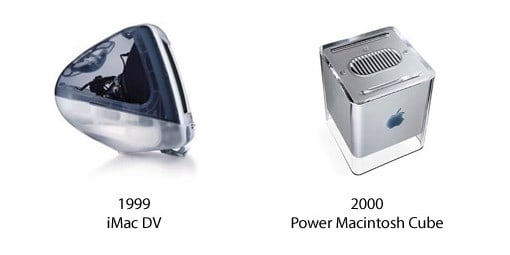
Power Mac G4 Cube

Power Mac G4 Cube Broschure The Power Mac G4 Cube (or, as Steve Jobs put it, „more affectionately, the G4 Cube“) was a compact Macintosh personal computer from Apple Inc. It was sold from 2000 to 2001. Its cube form factor is reminiscent of the NeXTcube from NeXT, acquired by Apple in 1996.
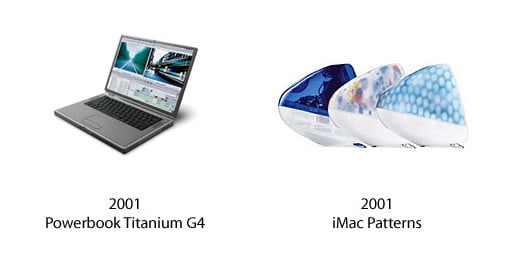
The diminutive 8″ x 8″ x 8″ cube suspended in a 10″ tall Acrylic (PMMA) enclosure, housed a PowerPC G4 processor running at 450 or 500 megahertz, and had an unconventional vertical slot loading DVD-ROM or CD-RW drive. A separate monitor — with either an ADC or VGA connection— was required for the Cube, in contrast to the all-in-one iMac series. Also unlike the iMacs, it had an upgradeable video card in a standard AGP slot. However, there was not enough space for full-length cards. The Cube also featured two FireWire ports, and two USB ports for connecting peripherals. Sound was provided by an external USB amplifier and a pair of Harman Kardon speakers. Although the USB amplifier had a standard mini-plug headphone output, it lacked any audio input. The Cube also used a silent, fanless, convection-based cooling system like the iMacs of the time.
References in Culture
The Power Mac G4 Cube with power supply, mouse, keyboard, speakers, and a Studio Display.
Apple Designer Jonathan Ive won several international awards for the Cube’s design. The Cube can be found in many publications related to design and some technology museums.It was also featured as Drew Carey’s (a noted Mac Fan) computer on The Drew Carey Show, in the kitchen of the design-conscious Eddy on Absolutely Fabulous, in the apartment of The Real World: Chicago and in Curb Your Enthusiasm in the office of Jeff Greene, Larry David’s manager. Also, Jack Bauer of the Fox series 24 had a Power Mac G4 Cube in his office at CTU Los Angeles. A Cube was used by the character ‚Will Yorkin‘ in One Hour Photo (2002), and in Jay and Silent Bob Strike Back you can see one in Ben Affleck’s house. In William Gibson’s 2003 novel Pattern Recognition, the character Cayce uses her film producer friend’s Cube while staying in his anti-designer London flat. The Cube was also featured in the early series of Will & Grace near the kitchen in Grace’s apartment and in Gilmore Girls on the hotel front desk.
History and sales
Apple targeted the Cube at the market between the iMac G3 and the Power Macintosh G4. Despite its innovative design, critics complained that it was too expensive. It was initially priced $200 higher than the comparably-equipped and more-expandable base Power Mac G4 of the time (450 MHz CPU, 64 MB RAM, 20 GB hard drive) and did not include a monitor, thus leading to slow sales. Additionally, early Cubes suffered from a manufacturing issue that led to faint lines (referred to as „cracks“ or „mold lines“) in the clear plastic case. This was often considered damaging to the aesthetic quality of the computer.
After seeing low profits, Apple attempted to increase sales by bundling more software with the Cube, lowering the price of the base model, incorporating a CD-RW drive standard for the 500 MHz version, and offering an improved NVIDIA graphics card as an option. These efforts could not offset the earlier perception of reduced value compared to the iMac and Power Mac G4 lineup. In July 2001 Apple issued a short and slightly unusual press release announcing the product was to be put „on ice.“
In 2003, the Apple Cube received a brief return to the spotlight after a series of articles in Wired magazine charted its cult popularity. The articles, focusing on upgrades installed by individual users and retailers such as Kemplar, led to a sharp rise in the Cube’s resale value. Nevertheless, with the release of the relatively inexpensive Mac mini (seen by some as a replacement), coupled with Apple’s switch to G5 processors and eventually Intel Core-based processors, the Cube again faded into the background.Modifications and upgrades
Since the Cube’s demise, a number of Cube enthusiasts have made modifications to their machines. Some of the more popular upgrades are high performance video cards (complete with ductwork to allow the GPU fan to work correctly in the small Cube case) and third-party CPU upgrade cards (up to 1.8 GHz per Aug. 2005); a few people have even modified their Cubes to take a dual-processor upgrade. A popular upgrade is the Geforce 2 MX, which exists in a version specially created for the Cube. Other popular changes include case modifications such as lighting and extra cooling. The Cube uses the same memory and hard drive components as a traditional desktop machine and these upgrades were common. Although the Cube uses a fanless convection-based cooling system, the mounting points for a standard desktop cooling fan are already in place. Upgraders of the Cube often take advantage of this to add a cooling fan to the system.
G4 Cube as an art piece
G4 Cube and its peripherals were showcased in The Museum of Modern Art, as well as in Digital Design Museum (a division of Design Museum).
Initial production of G4 Cube cases have ‚crack‘-like mold lines which does not affect the reliability of the machine, but it had a negative impact on the artistic design that Apple had marketed.References
Mac mini: Steve Jobs gets his Cube Back, Chuck Toporek on O’Reilly Mac Dev Center, January 2005
External links
- Apple – Power Mac G4 Cube courtesy of the Internet Archive
- Power Mac G4 Cube at apple-history.com
- Cube-Zone Web Site
- Gallery of G4 Cubes mods and desks
- Cube Owner Portal
- Gallery of customised G4 Cubes
- The television ad for the Cube (QuickTime format)
- Experimenting with high-intensity LEDs to illuminate a G4 Cube
Source:
Power Mac G4 Cube. (2008, October 11). In Wikipedia, The Free Encyclopedia. Retrieved 18:53, October 31, 2008, from http://en.wikipedia.org/w/index.php?title=Power_Mac_G4_Cube&oldid=244500888This article is licenced under the GNU Free Documentation License
Apple Power Mac G4 Cube Ad
httpv://www.youtube.com/watch?v=EuJvwvome1o
httpv://www.youtube.com/watch?v=4-PB86oy044
httpv://www.youtube.com/watch?v=D0NbGbZBPL0
Macworld New York 2000 – Presentation of the G4 Cube
-
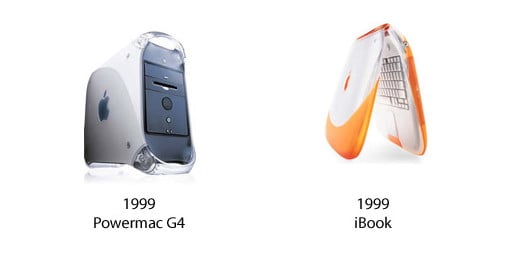
PowerMac G4 and iBook
httpv://www.youtube.com/watch?v=cdpRSj7tLiY
MacWorld Expo New York 1999 – Apple launched the first iBook -
Apple Macintosh
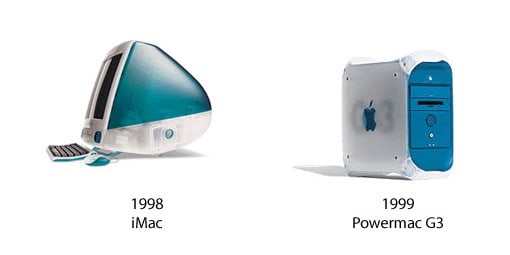
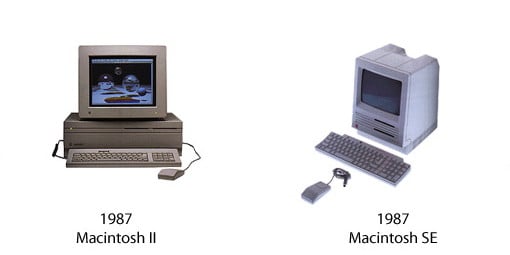
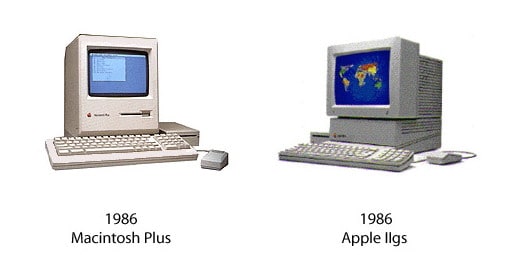
Macintosh, commonly nicknamed Mac is a brand name which covers several lines of personal computers designed, developed, and marketed by Apple Inc. The Macintosh 128K was released on January 24, 1984; it was the first commercially successful personal computer to feature a mouse and a graphical user interface (GUI) rather than a command line interface. Through the second half of the 1980s, the company built market share only to see it dissipate in the 1990s as the personal computer market shifted towards IBM PC Compatible machines running MS-DOS and Microsoft Windows. Apple consolidated multiple consumer-level desktop models into the 1998 iMac all-in-one, which sold extremely well and saw the Macintosh brand revitalized. Current Mac systems are mainly targeted at the home, education, and creative professional markets. They are: the aforementioned (though upgraded) iMac and the entry-level Mac mini desktop models, the workstation-level Mac Pro tower, the MacBook, MacBook Air and MacBook Pro laptops, and the Xserve server.
Production of the Mac is based on a vertical integration model in that Apple facilitates all aspects of its hardware and creates its own operating system that is pre-installed on all Macs. This is in contrast to most IBM compatible PCs, where multiple vendors create hardware intended to run another company’s software. Apple exclusively produces Mac hardware, choosing internal systems, designs, and prices. Apple does use third party components, however; current Macintosh CPUs use Intel’s x86 architecture. Previous models used the AIM alliance’s PowerPC and early models used Motorola’s 68k. Apple also develops the operating system for Macs, currently Mac OS X 10.5 „Leopard“. The modern Mac, like other personal computers, is capable of running alternative operating systems such as Linux, FreeBSD, and Microsoft Windows, the latter of which is considered to be the Mac’s biggest competitor
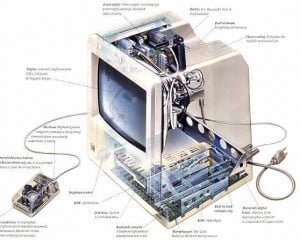
Apple Macintosh The Macintosh project started in the late 1970s with Jef Raskin, an Apple employee, who envisioned an easy-to-use, low-cost computer for the average consumer. In September 1979, Raskin was authorized to start hiring for the project, and he began to look for an engineer who could put together a prototype.

Bright engineers: Andy Hertzfeld, Chris Espinosa, Joanna Hoffman, George Crow, Bill Atkinson, Burrell Smith and Jerry Mannock Bill Atkinson, a member of Apple’s Lisa team (which was developing a similar but higher-end computer), introduced him to Burrell Smith, a service technician who had been hired earlier that year. Over the years, Raskin assembled a large development team that designed and built the original Macintosh hardware and software; besides Raskin, Atkinson and Smith, the team included Chris Espinosa, Joanna Hoffman, George Crow, Jerry Manock, Susan Kare, Andy Hertzfeld, and Daniel Kottke.
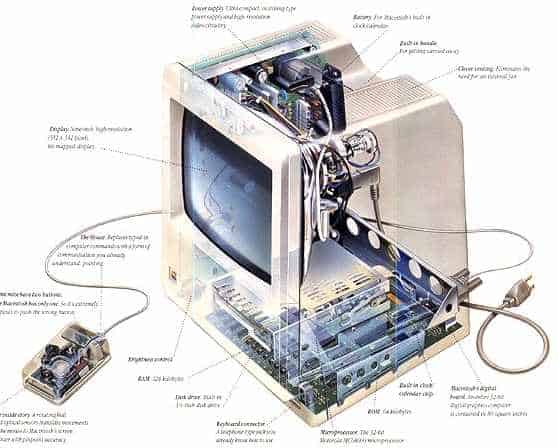
Macintosh Commercial Smith’s first Macintosh board was built to Raskin’s design specifications: it had 64 kilobytes (KB) of RAM, used the Motorola 6809E microprocessor, and was capable of supporting a 256×256 pixel black-and-white bitmap display. Bud Tribble, a Macintosh programmer, was interested in running the Lisa’s graphical programs on the Macintosh, and asked Smith whether he could incorporate the Lisa’s Motorola 68000 microprocessor into the Mac while still keeping the production cost down. By December 1980, Smith had succeeded in designing a board that not only used the 68000, but bumped its speed from 5 to 8 megahertz (MHz); this board also had the capacity to support a 384×256 pixel display. Smith’s design used fewer RAM chips than the Lisa, which made production of the board significantly more cost-efficient. The final Mac design was self-contained and had the complete QuickDraw picture language and interpreter in 64 Kb of ROM – far than most other computers; it had 128 KB of RAM, in the form of sixteen 64 kilobit (Kb) RAM chips soldered to the logicboard. Though there were no memory slots, its RAM was expandable to 512 KB by means of soldering sixteen chip sockets to accept 256 Kb RAM chips in place of the factory-installed chips. The final product’s screen was a 9-inch, 512×342 pixel monochrome display, exceeding the prototypes.
The original 1984 Mac OS desktop featured a radically new graphical user interface. Users communicated with the computer not through abstract lines of code but rather using a metaphorical desktop that included items that the user was already familiar with.
The design caught the attention of Steve Jobs, co-founder of Apple. Realizing that the Macintosh was more marketable than the Lisa, he began to focus his attention on the project. Raskin finally left the Macintosh project in 1981 over a personality conflict with Jobs, and the final Macintosh design is said to be closer to Jobs’ ideas than Raskin’s.
After hearing of the pioneering GUI technology being developed at Xerox PARC, Jobs had negotiated a visit to see the Xerox Alto computer and Smalltalk development tools in exchange for Apple stock options. The Lisa and Macintosh user interfaces were partially influenced by technology seen at Xerox PARC and were combined with the Macintosh group’s own ideas. Jobs also commissioned industrial designer Hartmut Esslinger to work on the Macintosh line, resulting in the „Snow White“ design language; although it came too late for the earliest Macs, it was implemented in most other mid- to late-1980s Apple computers.[4] However, Jobs’ leadership at the Macintosh project was short-lived; after an internal power struggle with new CEO John Sculley, Jobs angrily resigned from Apple in 1985, went on to found NeXT, another computer company, and did not return until 1997.
1984: Introduction
This television commercial, which aired during the Super Bowl, launched the original Macintosh.
The Macintosh 128k was announced to the press in October 1983, followed by an 18-page brochure included with various magazines in December. The Macintosh was introduced by the now famous US$1.5 million Ridley Scott television commercial, „1984“. The commercial most notably aired during the third quarter of Super Bowl XVIII on 22 January 1984 and is now considered a „watershed event“ and a „masterpiece.“ 1984 used an unnamed heroine to represent the coming of the Macintosh (indicated by her white tank top with a Picasso-style picture of Apple’s Macintosh computer on it) as a means of saving humanity from „conformity“ (Big Brother). These images were an allusion to George Orwell’s noted novel, Nineteen Eighty-Four, which described a dystopian future ruled by a televised „Big Brother.“For a special post-election edition of Newsweek in November 1984, Apple spent more than US$2.5 million to buy all 39 of the advertising pages in the issue. Apple also ran a “Test Drive a Macintosh” promotion, in which potential buyers with a credit card could take home a Macintosh for 24 hours and return it to a dealer afterwards. While 200,000 people participated, dealers disliked the promotion, the supply of computers was insufficient for demand, and many were returned in such a bad shape that they could no longer be sold. This marketing campaign caused CEO John Sculley to raise the price from US$1,995 to US$2,495 (adjusting for inflation, about $5,000 in 2007).
Two days after the 1984 ad aired, the Macintosh went on sale. It came bundled with two applications designed to show off its interface: MacWrite and MacPaint. Although the Mac garnered an immediate, enthusiastic following, it was too radical for some, who labeled it a mere „toy.“ Because the machine was entirely designed around the GUI, existing text-mode and command-driven applications had to be redesigned and the programming code rewritten; this was a challenging undertaking that many software developers shied away from, and resulted in an initial lack of software for the new system. In April 1984 Microsoft’s MultiPlan migrated over from MS-DOS, followed by Microsoft Word in January 1985. In 1985, Lotus Software introduced Lotus Jazz after the success of Lotus 1-2-3 for the IBM PC, although it was largely a flop. Apple introduced Macintosh Office the same year with the lemmings ad. Infamous for insulting its own potential customers, it was not successful.
Feature stories about the Apple Macintosh on this web site:
- The history of the Apple Macintosh
- It all began with “Annie” – The Vision of a Computer for the Masses
- Rich Neighbour with Open Doors – Apple and Xerox PARC
- Steve Jobs discovers the Macintosh Project
- “1984″ – The famous Super Bowl Ad
- Archrival and Knight in Shining Armor – Microsoft’s Relationship with Apple
- Showdown at Apple: John Sculley vs. Steve Jobs
- The Macintosh – The many facets of a slightly flawed gem – reprint from the magazine “Byte” (1984)
Source:
Macintosh. (2008, October 9). In Wikipedia, The Free Encyclopedia. Retrieved 17:51, October 12, 2008, from http://en.wikipedia.org/w/index.php?title=Macintosh&oldid=244185329
This article is published under the GNU General Public License
- The history of the Apple Macintosh