Kategorie: Apple-People

  • Ron Wayne – The third Apple founder

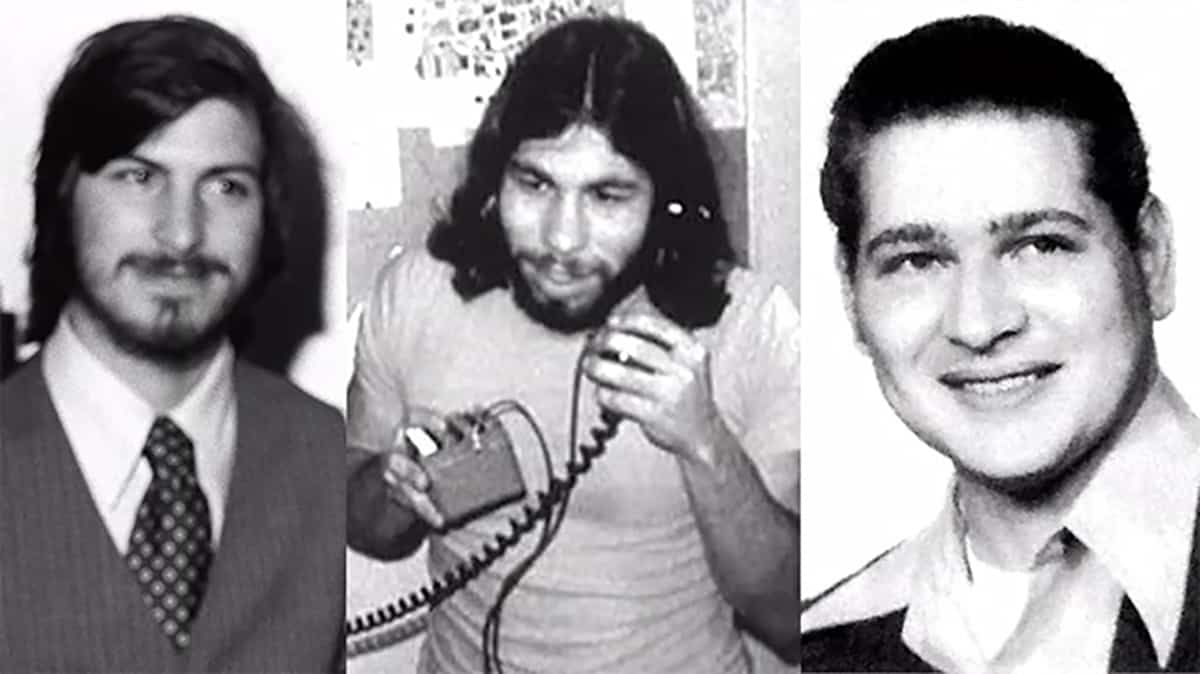
    When you talk about the founders of Apple, you first think of Steve Jobs and Steve Wozniak. Jobs, the far-sighted business strategist – and „Woz“, the brilliant inventor. In fact, the Apple Computer Company was founded by three men: „Mr. Stephen G. Wozinak, Mr. Steven P. Jobs and Mr. Ronald G. Wayne“, as it is also stated in the company’s founding contract of April 1, 1976.

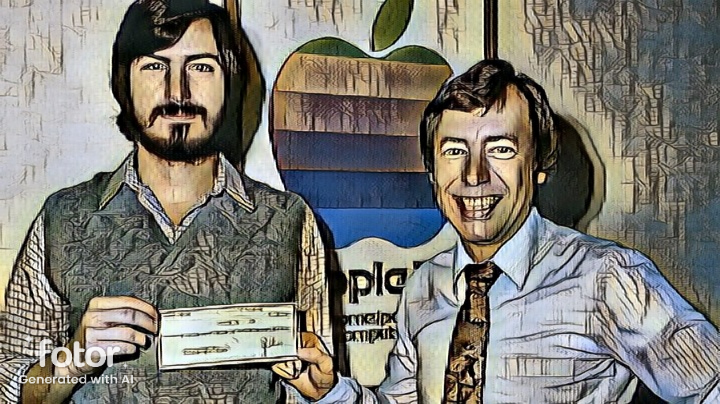
    Unterschriften unter dem Gründungsvertrag von Apple vom 1. April 1976
    Three men founded Apple Computer on April 1st, 1976

    Ron Wayne worked at Atari before founding Apple Computer, where he met Steve Jobs, who was involved in new game development. Through Jobs, Wayne became aware of Steve Wozniak, a brilliant hardware designer and engineer who had created the first usable personal computer that would go down in technological history as the Apple I.

    But it soon became clear that the two Steves were pursuing very different goals: Steve Wozniak wanted to impress his pal’s guys at the Homebrew Computer Club with his brilliant development steps. Woz had no serious interest in making a big business out of it. Steve Jobs, on the other hand, quickly recognized the business potential. With a computer like Apple, I could break the dominance of the mainframes of companies like IBM and turn the personal computer into a mass product.

    However, Jobs was not able to match his interests with Woz. Therefore he relied on Ron Wayne. So he and against this background offered him a minority share in the foundation of Apple Computer on April 1, 1976. Wayne had a 10 percent stake in the company, and Jobs and Wozniak each held 45 percent. Ron Wayne was to tip the scales when the two main players were at loggerheads with each other. „We both trusted him so much that he would resolve any conflicts we had,“ said Steve Jobs.

    The first larger order came from the Byte Shop

    r Wayne got cold feet: „I was practically the adult in the room. I was in my 40s, those kids were around 20. Then about a week and a half later, when I had time to think, I did what most people thought was absolutely crazy. I had my name taken off the contract.“

    Wayne was particularly worried about the financial obligations associated with the first major contract for Apple computers. Jobs was in the process of signing supply contracts for the Apple I with first customers like „The Byte Shop“. He was getting the components for it on tick.

    „I had very good reasons to remove my name from the contract,“ Wayne said in a 2016 TV interview looking back. „The main reason was that we had started a company. And if we failed, Jobs and Woz would not have had two nickels in their pockets. Who would be left to stick? Well, I had a house and a car, and a bank account, too. I was handy. So I was financially vulnerable. But I also wanted to be my own man. I also realized I was in the shadow of two grand. I was never gonna get my own project. I didn’t like the idea of spending the next 20 years behind piles of paper in an office. That was another reason to get out.“

    Ron Wayne talks to Jules Pochy und Jérôme Schmidt (2016)

    His co-founder Steve Wozniak could not understand this step. „I don’t know why Ron gave up. „He sold his shares and got out. He may have had good reasons. He got out and he was happy with it. He couldn’t see the big picture. But you couldn’t see the big picture at the time. There was only the Apple I.“

    Wayne could not count on Steve Jobs‘ understanding. Jobs described the process as follows: „He decided that he really wanted a VCR or something. So he sold us back 10 percent for eight hundred dollars.“

    But there were also reservations in the opposite direction: „I didn’t know whether jobs were the kind of personality I wanted to work for either,“ Wayne said in the ARTE interview (2016). „He was just the way he was. He knew exactly what he wanted to do. And it was better not to get in his way. You would end up with a footprint on your forehead. Jobs had a very aggressive character. And if you had to choose between Steve Jobs and an ice cube to warm them up, you’d snuggle up to the ice cube. But it was the only way he could achieve what he had achieved with Apple. Apple was Steve Jobs.“

    So Wayne has no regrets about getting out of Apple so early: „Those kids were wild hotshots, like whether you have to hold a tiger by the tail. If I’d stayed with Apple, I’d have been caught in a hurry. I’d just be the richest man in the cemetery.“

    One thing in life Wayne does regret, though. In the mid-nineties, he saw an ad in a magazine for a company that dealt with autographs and signatures. He remembered the old Apple contract that was lying around in a closet collecting dust. Finally, he sold the historical document for 500 dollars to the autograph dealer.

    Years later, Wayne then saw on television how his old contract came under the hammer for almost 1.6 million dollars at the Sotheby’s auction house.

    „I’m sorry for this incident. But what can I say? It’s the story of my life, right? A day late and a dollar short in my pocket.“

    Ron Wayne has left his mark on Apple’s history even after he left as a shareholder. The first trace should be removed quickly because Steve Jobs did not like the first logo of the young company, which Wayne had designed. „In this logo, which they had me design, I captured Wozniak’s bizarreness. The logo with Newton in this Gothic frame with the ribbon and the inscription ‚Apple Computer Company‘ was of course a 19th-century design, not a 20th-century design. I knew that already.“

    The second mark was deeper: Jobs asked Wayne if he could design a case for the Apple II. Although his design was never used. But Apple adopted the basic design principle.

    Dieses Bild hat ein leeres Alt-Attribut. Der Dateiname ist entwurf_apple_ii_geaeuse_wayne-640x360.jpg
    Design for a housing for the Apple II by Ron Wayne.

    To this day, Wayne is amused by the thought that he may have influenced all his later work. „A typical computer today consists of a tower and a circuit board mounted vertically. The keyboard and screen are separate. In my design for the Apple II, I had a horizontal design with a horizontally mounted board. The keyboard was integrated into the housing. The monitor stood on top, as one unit. They used this design for all future models, the Macintosh and Lisa, and so on. All were built this way. This form was unique among modern computers.“

    BBC feature about Ron Wayne
  • John Sculley: „Steve Jobs was misrepresented in popular culture“

    Steve Jobs and John Sculley on the Cover of Business Week (Nov. 1984)
    Steve Jobs and John Sculley on the Cover of Business Week (Nov. 1984)

    Rhiannon Williams, writing for The Telegraph, had the chance to interview John Sculley, the man who was instrumental in ousting Steve Jobs from Apple back in 1985.

    When asked if he ever feels frustrated at how Jobs is presented, or misrepresented, in popular culture, Sculley pauses. “Misrepresented in what way?” he asks, tersely. People tend to draw on the more tyrannical aspects of his personality, I venture.

    “I don’t think that’s fair. I think…” He pauses again. “People exaggerate, it’s simple to summarise and exaggerate. I found Steve, remember – at the time we were friends, we were incredibly close friends, and… he was someone who even then, showed compassion, and caring about people. “Didn’t mean he couldn’t be tough in a meeting and make decisions, and sometimes they seemed, y’know, overly harsh. But the reality was, the Steve Jobs I knew was still a very decent person, with very decent values. So I think he was misrepresented in popular culture.”

    And:

    The pair worked in harmony together on Apple’s 1984 Ridley Scott-directed Super Bowl television advert, but cracks began to appear when Sculley disagreed with Jobs’ plans to drop the price of the Macintosh and direct a large proportion of the marketing budget from Apple II to the Mac in the wake of the poorly-received Macintosh Office network, which later became Desktop Publishing.

    “I said ‘Steve, the only cash for the company is coming from the Apple II, and we can’t do that,’” Sculley recalls sadly.

    The working relationship between the two descended into a desperate struggle for power. The increasingly-erratic Jobs tried to lead an unsuccessful rebellion against Sculley in May 1985 with the goal of replacing him with Jean-Louis Gassée, then Apple’s director of European Operations. Gassée informed Sculley of the coup, who confronted Jobs at an executive committee meeting and demanded those present choose between the two men as to who they thought best to run the company. They backed Sculley, and Jobs fled the room.

    Former Apple CEO on Apple’s rise to $1 trillion from CNBC.

  • TechRepublic – The remarkable odyssey of Bill Fernandez 

    Perhaps best known as the guy who introduced Steve Jobs and Steve Wozniak, Bill Fernandez speaks out on Apple’s founding magic, how love built the first Mac, and the interface of the future.

    Bill Fernandez holds an Apple I, with an Apple II on the desk.  Photo courtesy of Bill Fernandez
    Bill Fernandez holds an Apple I, with an Apple II on the desk.
    Photo courtesy of Bill Fernandez

    The Apple II got there first. It was the Wright Flyer I of personal computers.When the Wright brothers made their historic first flight in 1903, lots of other inventors were trying to fling their own shoddy little planes into the air. And in 1977, when Steve Wozniak and Steve Jobs unveiled the Apple II, there were a zillion other nerds working on building a personal computer.

    But Woz beat them to it, and Jobs knew how to sell it.The Apple II was the product that turned Apple into Apple. It was the iPhone of its era, the product that redefined every machine like it that came afterward.Its real magic was Wozniak’s minimalism. He integrated many technologies and components that no one else had put together in the same device, and he did it with as few parts as possible. It was, as Wozniak wrote in his autobiography, „the first low-cost computer which, out of the box, you didn’t have to be a geek to use.

    „But as genius as Wozniak was, the Apple II almost didn’t make it out of his brain and into a product that the rest of the world could use.Daniel Kottke, one of Apple’s first dozen employees, said, „[In 1976] the Apple II did not even work. Woz’s prototype worked. But when they laid it out as a circuit board, it did not work reliably… It was unacceptable. And Woz did not have the skills to fix that… But, it was even worse than that. They did not even have a schematic.“

    Newly funded by investors, Apple had just hired Rod Holt as the company’s first engineering chief, and this was one of the big problems that Holt walked into when he took the job. At the time Woz’s Apple II prototype was a bunch of wires and chips in a cardboard shoebox. The tiny Apple team had to take this amazing concept machine and turn it into a product that could be manufactured and sold in stores.So Holt handed the first task to Apple technician Bill Fernandez.

    Source: Apple’s first employee: The remarkable odyssey of Bill Fernandez – Feature – TechRepublic

  • The Wizards behind the Macintosh

    The making of Macintosh – An Interview with The Macintosh Design Team (Byte – Feb, 1984)

    Bill Atkinson
    Bill Atkinson

    Bill Atkinson nearly had his Ph.D. in neurochemistry before he admitted to himself that his real love was computers. He “got a quick E.E.” and started his own company. He was happily minding his own business when his friend ]eff Raskin asked him to come see what was happening at Apple, which was then six months old. Bill wasn’t really interested, but airplane tickets showed up in the mail, so he took a look. What he saw was “several years reaching into the future” of anything he could do where he was. He stayed to write Apple’s Pascal and later became Mr. User Interface for Lisa before he moved over to the Mac team.


    Andy Hertzfeld
    Andy Hertzfeld

    Andy Hertzfeld says, “The Apple II changed my life.” The computer people at Berkeley were a little narrow-minded about letting a grad student really get into the computer as Andy wanted to. So he spent nearly all the money he had in the world on an Apple II and had a computer he could control completely. He decided the Apple was more interesting than his classes and began writing programs for magazines. When Apple bought one of Andy’s programs, Steve Jobs offered him a job, which he took when he finished school. He worked on silent-type printers and Apple III demos until a shake-up in his part of the company shook him loose. He looked around and decided to go with Mac.


    Larry Kenyon
    Larry Kenyon

    Larry Kenyon arrived at Apple from Amdahl with a double degree in psychology and computer science. He was working on Apple III products when the same shake-up that shook Andy loose freed him, too. Andy asked Larry to join the Mac crew because he was one of the few people who understood the arcane art of making the Apple II work with printer peripherals, and anybody who can do that has to be good. No one in the company really believed that Mac was a product when Larry joined the Mac team. It was just a research effort, and there was some risk involved: would you still have your job in a few months?

    Joanna Hoffman
    Joanna Hoffman

    Joanna Hoffman is still on leave from her Ph.D. program in archaeology at the University of Chicago. She has a background in anthropology, physics, and linguistics. She came to Apple because of Mac. After using her computer skills in the field of archaeology for so long, she was tired of looking at the past and turned to the future. She was Mac’s entire marketing department for more than a year. She wants to make Mac a tool that feels natural for international users by making it speak their languages.


    Burrell Carver Smith
    Burrell Carver Smith

    Burrell Carver Smith encountered the Homebrew Computer Club in 1975, got hooked on microprocessors, and moved to the Bay Area. Just riding around in a borrowed truck one day, he saw Apple and decided to drop in. The only job Apple had available was in the service department, repairing Apple IIs. He took the job and fixed at least a thousand Apple II boards and got involved in other projects before Jeff Raskin and Bill Atkinson recruited him for Mac. He talked the Lisa engineers out of some chips and stuff and got a prototype running over Christmas 1979. He was the first full-time Mac person after Jeff Raskin.


    8-chris-espinoza-was-working-at-apple-part-time-in-high-schoolChris Espinosa says, „There was no life before Apple.” At 13 years old he could be found cruising up and down the bus line in his home town, spending a few hours at each Byte Shop on the line until the owner threw him out. He discovered the way to keep from getting thrown out was to write demo programs for the machines, so he wrote for whatever was lying around: ”Altairs, IMSAIs, or this weird new machine called Apple I. His mom worried when he was offered a ride to the Homebrew Computer Club meeting with two scruffy characters named Jobs and Wozniak, but she gave in, and the rest is history. Chris spent a Christmas vacation debugging Apple’s BASIC in exchange for a whole row of 4K-byte RAM chips, which he thought was a pretty good deal. He worked part-time during college writing BASIC programs and reference manuals and signed on full-time when he graduated. He likes being in on the design process: ”If the machine is designed right in the first place, you don’t have to write a lot about it.”

    Jerry Manock
    Jerry Manock

    Jerrold C. Manock was a freelance product-design consultant with a Stanford education who finally joined Apple when he saw that three-quarters of his billing was to Apple anyway. He worked on the Apple II, the Disk II, the III, and Lisa before designing Mac. In Macintosh, he says, “The outside matches the inside in elegant simplicity.”


    Bruce Horn grew up at Xerox PARC, much the same way Chris grew up at Apple, and later attended Stanford. Bruce started working at Xerox when he was 14 years old: he was one of the kids Xerox brought in to test Smalltalk. Turns out he was brighter than most and became a systems wizard who actually implemented Smalltalk on a variety of different processors. Bruce is all of 23 years old now, but he spent seven years at Xerox PARC and brought Apple that perspective.

    George Crowe and David Egner designed the analog board in the Macintosh.

    Steve Capps assisted Andy Hertzfeld with the systems software.


    https://www.youtube.com/watch?v=u2jM054-wfk

  • Steve Wozniak Debunks One of Apple’s Biggest Myths

    In 1976, The Apple 1 computer went on sale for a retail price of $666.66. Steve Wozniak, who co-founded Apple with Steve Jobs and designed that product, remembers the early days.

    Read more:
    Bloomberg BusinessWeek: Steve Wozniak on Apple, the Computer Revolution, and Working With Steve Jobs
     

    [contextly_auto_sidebar id=“iX1z5W9NTUIkyDLrMMFbcNhDx4Xv0wjj“]

  • Jony Ive in Conversation with Vanity Fair’s Graydon Carter

    Vanity Fair editor Graydon Carter and Apple’s senior vice president of design, Jonathan Ive, sat down for a wide-ranging discussion at the Vanity Fair New Establishment Summit in San Francisco.

    Ive spoke candidly about what he learned from late Apple founder and C.E.O. Steve Jobs, how he feels about competitors whose products border on “theft,” and his own development as a designer. He also shared the specifics of his daily routine, and offered an in-depth look at the creative process of Apple’s core design team.

    [contextly_auto_sidebar id=“bPqx8PdJWu0kdbQ0gCaKNCC8NxvOZJF7″]

  • Tim Cook: I’m proud to be gay

    Apple’s chief executive publicly confirmed that he is gay in an essay published by Bloomberg Businessweek. The 53-year-old wrote he was inspired by Dr Martin Luther King to set aside his desire for privacy to do „something more important.“

    Cook said he hopes to support and inspire others by coming out.

    While I have never denied my sexuality, I haven’t publicly acknowledged it either, until now. So let me be clear: I’m proud to be gay, and I consider being gay among the greatest gifts God has given me.

    Cook said he would continue to advocate for human rights and equality. „We pave the sunlit path toward justice together, brick by brick. This is my brick.“
    Many colleagues already knew about his sexual orientation, he said.
    On Twitter co-workers and colleges showed support for Cook.

    https://twitter.com/pschiller/status/527806723524792321


    [contextly_auto_sidebar id=“EyV1FX3hSFxlyvG0n8E7Dxi2Xxmonfds“]

  • Tim Cook at Auburn University: „Cross-burning was a Symbol of Ignorance“

    Tim Cook

    Apple CEO Tim Cook isn’t known for talking much about himself, but in a speech this week, he talked about some of the early childhood experiences that shape his passions around fighting for human rights and equality.

    “Growing up in Alabama in the 1960s, I saw the devastating impacts of discrimination,” Cook said, accepting a lifetime achievement award from Auburn University, his alma mater. “Remarkable people were denied opportunities and treated without basic human dignity, solely because of the color of their skin.”

    He talked about seeing a cross-burning at the home of a nearby family.
    “This image was permanently imprinted in my brain, and it would change my life forever,” Cook said. “For me, the cross-burning was a symbol of ignorance, of hatred, and a fear of anyone different than the majority. I could never understand it ,and I knew then that America’s and Alabama’s history would always be scarred by the hatred that it represented.”

    More at AllThingsD

  • Jony Ive and Marc Newson at Charlie Rose

    Marc Newson, Jony Ive, and Charlie Rose
    Marc Newson, Jony Ive, and Charlie Rose (Source: @charlierose)

    Jony Ive, Senior Vice President of Design at Apple and industrial designer Marc Newson discuss their (Red) collaboration at Sotheby’s.

    Simplicity is refining and being able to define the very essence of what something does, and therefore you understand what it is and you understand what it does….but simplicity for us, it’s not just the absence of clutter, it’s not just stuff that’s not there, it’s this tremendous gravity to trying to find that very simple solution.

    Ive and Newson have collaborated numerous times throughout the past few months to select and customize products for Sotheby’s charity auction to benefit Product (RED), including a one-of-a-kind Leica camera, an aluminum desk, solid gold Apple EarPods, and a one-of-a-kind red Mac Pro. Product (RED) has been a longtime Apple partner, with the company raising more than $65 million for the charity since 2006.

  • Blue Box – Why Steve Jobs and Steve Wozniak hacked the phone network

    Before Steve Wozniak and Steve Jobs built Apple in the 1970s, they were phone phreaks.

    YouTube-Link

    In his famous interview with Bob Cringley for PBS TV series „Thriumpf of the nerds“, Steve Jobs said:
    We read about (…) the story Esquire magazine about this guy named „Captain Crunch“, who could supposedly make free telephone calls. You heard about this, I’m sure. And we – again – were captivated: How could anybody do this? And we thought, it must be a hoax. And we started looking through libraries, looking for the secret tones that would allow you to do this. And it turned out we were at Stanford Linear Accelerator Centre one night, and way in the bowels of their technical library way down at the last bookshelf in the corner bottom rack we found an AT&T technical journal that laid out the whole thing. And that’s another moment I’ll never forget – we saw this journal we though – „My God, it’s all real“ – (laughs) and so we set out to build a device to make these tones.

    And the way it worked was: You know, you make a long-distance call, you used to hear „tüdülüdülü“ right in the background. They were tones that sounded like the touch tone you can make on your phone. But they were different frequencies, so you could make them. It turned out, that was the signal from one telephone computer to another – controlling the computers on the network. And AT&T made a fatal flaw when they designed the original telephone network, digital telephone network. They put the signaling from computer to computer in the same band as your voice, which meant, that if you could make those same signals you could put it right in through the handset. And literally the entire AT&T international phone network would think, you were an AT&T computer.

    So after three weeks we finally built a box like this that worked. And I remember the first call we made was down to L.A. to one of Woz’s relatives down in Pasadena. We dialed the wrong number, but we woke some guy up in the middle of the night – yelling at him like „Don’t you understand? We made this call for free!“. And this person didn’t appreciate that. But it was miraculous. And we built these boxes to do „blue boxing“, as it was called. An we put a little note in the bottom of them. Our logo was: „He’s got the whole world in his hand“. (laughs) And they worked.

    >We built the best blue box in world. It was all digital, no adjustments. And you could go to a pay phone, and you could take a trunk over White Plaines, then take a satellite over Europe and go to Turkey, take a cable back to Atlanta, you could go around the world, around the world five or six times. Because we learned all the codes for how to get on the satellite and stuff. And then you could call a pay phone next door, and you could shout in the phone and after about a minute would come out the other phone. It was miraculous.

    And you might ask: „What so interesting about that?“ What’s so interesting is that we were young and what we learned was, that we could build something ourselves that could control billions of dollars‘ worth of infrastructure in the world. That was what we learned. That it was us two – you know, we didn’t know much – we could build a little thing, that could control a giant thing. And that was incredible lesson. I don’t think there would have ever been an Apple Computer had there not been blue boxing.

    Bob Cringely: Woz said, you called the Pope.

    Steve Jobs: Yes, we did call Pope. He pretended to be Henry Kissinger. We got the number of the Vatican. And we called the Pope. They started waking people up in the hierarchy, you know. I don’t know, cardinals and this and that. And they actually sent someone to wake up the Pope. When finally we just burst out laughing they realized that we weren’t Henry Kissinger. And so we never got to talk to the Pope. But it was very funny, so.

    ———————————-

    Woz remembers blue boxing:

    So we’re sitting in the payphone trying to make a blue box call. And the operator comes back on the line. And we’re all scared and we’d try it again. … And she comes back on the line; we’re all scared so we put in money. And then a cop car pulls up. And Steve was shaking, you know, and he got the blue box back into my pocket. I got it– he got it to me because the cop turned to look in the bushes for drugs or something, you know? So I put the box in my pocket. The cop pats me down and says, „What’s this?“ I said, „It’s an electronic music synthesizer.“ Wasn’t too musical. Second cop says, „What’s the orange button for?“ „It’s for calibration,“ says Steve.

    — Steve Wozniak,
    lecture at Computer History Museum, 2002

    Wozniak and Jobs Blue Box, ca. 1972. The Blue Box allowed electronics hobbyists to make free telephone calls.
    Wozniak and Jobs Blue Box, ca. 1972. The Blue Box allowed electronics hobbyists to make free telephone calls.

    The „Blue Box“ was a simple electronic gizmo that bypassed telephone company billing computers, allowing anyone to make free telephone calls anywhere in the world.

    The „two Steves“ had a great deal of fun building and using them for „ethical hacking,“ with Wozniak building the kits and Jobs selling them—a pattern which would emerge again and again in the lives of these two innovators. (Wozniak once telephoned the Vatican, pretended to be Henry Kissinger and asked to speak to the Pope—just to see if he could. When someone answered, Woz got scared and hung up.)

    These early playful roots are what Wozniak remembers most fondly of Jobs. As columnist Mike Cassidy recalled in a San Jose Mercury News interview, what these two friends most remembered was „not bringing computers to the masses … or the many ‚aha‘ moments designing computers. Instead, it’s the time the two tried to unfurl a banner depicting a middle finger salute from the roof of Homestead High School…“ or their many Blue Box exploits. Walter Isaacson, Jobs’s official biographer, cites Jobs reflecting on the Blue Box:

    If it hadn’t been for the Blue Boxes, there would have been no Apple. I’m 100% sure of that. Woz and I learned how to work together, and we gained the confidence that we could solve technical problems and actually put something into production.

    (Isaacson, p. 30)

    So far with the story told by Steve Jobs building ‚blue boxes‘ about making free phone calls around the world. Now hear it directly from the man who gave Steve Job the idea. Steve Wozniak found a „fiction“ article with too much detail to be false. They helped themselves to the library at the Stanford Linear Accelerator and discovered the article was, in fact, real.
    But he emphasizes they called around the world to explore not to rip off Ma Bell. All his legit calls were made from home and he had a high phone bill as a result.

    (This is an Oct. 4, 1984 speech the Apple co-founder gave to the Denver Apple Pi club at the Colorado School of mines. NOTE: This is assembled from two dubs to fix playback errors. Every word is included, but video quality worsens in the second half.) Kudos to Vince Patton who discovered this video.

    ——————————–

    Source: Computer History Museum

    Silicon Valley Historical Association